by Lori Berson | Oct 10, 2026 | Creative Services, Digital marketing, Marketing, Marketing Strategy
-
Safe marketing is a 100% budget waste. In crowded industries, generic messaging is invisible. If buyers can’t spot a clear difference, decisions default entirely to price and convenience.
-
Creativity belongs in strategy, not production. Stop using creative teams as “visual janitors” to make approved decks look pretty. Involve creative thinkers early to shape core positioning and messaging.
-
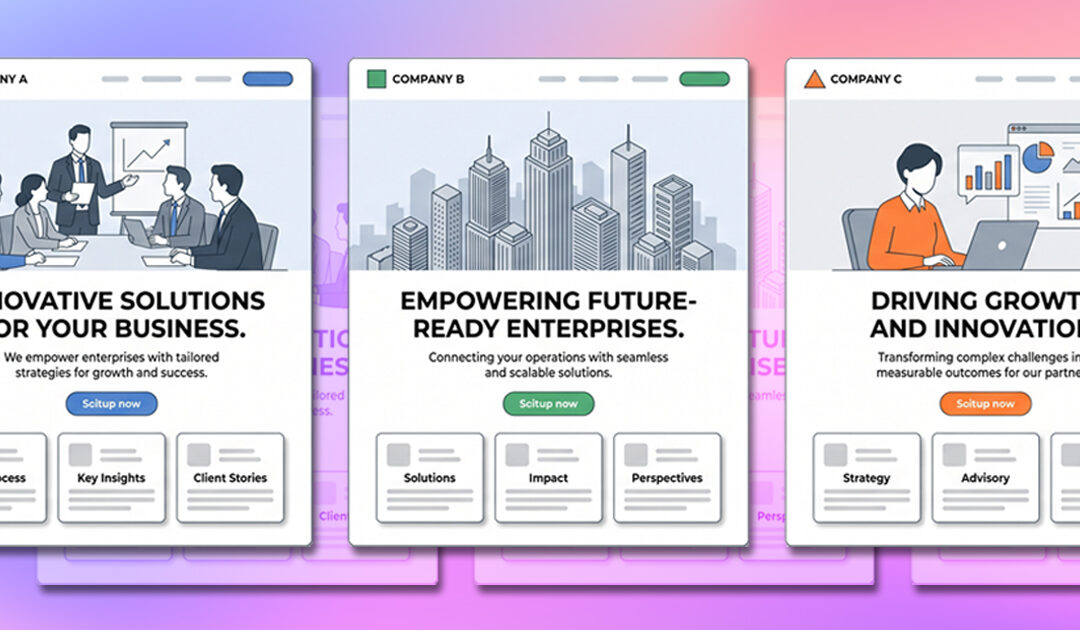
Pass the “Blindfold Test.” If you strip the logos off your website and marketing materials and can’t distinguish them from three key competitors, you don’t have a distinct strategy; you have an expensive template.
-
AI makes generic content worthless. AI makes producing boilerplate text fast and cheap. If an algorithm can write your value proposition in 30 seconds, your strategy was already a collection of industry clichés.
-
Ban empty “corporate” words. Swap vague descriptors like flexible, seamless, innovative, and trusted for specific proof: clear turnaround times, direct expert access, and measurable client outcomes.
Most B2B marketing doesn’t fail because it looks bad. It fails because it looks like everyone else.
You’ve checked every box: slick website, active social channels, polished sales decks, and consistent email campaigns. You’re doing everything “right.” Yet, if you swapped your logo with your primary competitor’s tomorrow morning, would your prospective customers actually notice?
In risk-averse industries like financial services and health insurance, where companies offer similar products, promote similar benefits, and make similar promises, blending in is the riskiest strategy you can take. Safe, invisible marketing wastes 100% of its budget.
When prospects can’t spot a meaningful difference between options, decisions default to price, convenience, or inertia.
That’s where strategic creativity changes the game. Creativity isn’t simply about producing attractive marketing materials; it’s a business asset designed to communicate value, attract better prospects, and carve out a defensible competitive advantage.
The Hidden Cost of Playing It Safe
Consider two commercial lenders competing for the exact same client.
The first promotes “flexible financing, competitive rates, and exceptional customer service.”
The second explains how its funding structure helped a regional manufacturer purchase equipment, fulfill a sudden 40% spike in orders, and protect working capital without touching their primary credit line.
Both lenders may offer identical capabilities. But the second lender demonstrates real-world problem solving, proves industry expertise, and respects the buyer’s intelligence.
The difference isn’t the core product; it’s how value is framed and communicated.
When every competitor promises “customized solutions” and “unmatched support,” those phrases lose all meaning and become background noise. Effective creative strategy bridges the gap between what your business offers and what your customers actually care about.
Creativity Belongs in Business Strategy, Not Just “Production”
Too many organizations bring creative teams in after every important decision has already been made.
The strategy is approved. The message is written. The deck is finalized. Then someone hands it off with a single directive: “Make this look pretty.”
If you only bring creative thinkers in at the finish line, you’re treating them like visual janitors, not strategic partners. You miss out on much of creativity’s actual business value.
Strategic creative services should shape the positioning itself: identifying what genuinely makes your company different, uncovering underlying customer motivations, challenging tired industry conventions, and finding more memorable ways to communicate.
When strategy and creativity align from day one, you gain three distinct advantages:
-
A Distinctive Market Signal: You build visual and verbal hooks that prospects recognize and remember immediately.
-
Higher-Quality Prospects: You stop chasing cold leads and start attracting buyers who specifically want your approach.
-
A Defensible Brand: You demonstrate expertise in ways competitors cannot easily replicate with a template.
Three Warning Signs Your Marketing Has a “Blink” Problem
Throwing more budget at content production won’t fix a weak positioning strategy. Look out for these three red flags:
-
You’re attracting traffic, but zero qualified inquiries. Your website receives clicks, but visitors bounce without taking action. The issue usually isn’t design; it’s messaging that fails to explain why your services matter to high-value buyers.
-
Prospects constantly grind you on price. If buyers can’t spot a clear, valuable difference between you and the competition, price becomes their default tiebreaker. Strong creative strategy highlights outcomes that justify your margins.
-
Your marketing is consistent, but entirely forgettable. Campaigns launch on schedule and look professional, yet response rates flatline. You’re broadcasting information without giving people a visceral reason to care or act.
Five Ways to Turn Creativity Into a Growth Engine
You don’t need to burn down your brand identity and start over. Start by auditing what you already have:
-
Run the “Blindfold Test” on your homepage. Print out your website hero section alongside three main competitors. Cover the logos and company names. Hand them to someone outside marketing. If they can’t pick yours out in 10 seconds, you don’t have a distinct strategy; you have an expensive template.
-
Ban “empty promise” adjectives. Words like flexible, trusted, seamless, and innovative are corporate filler. Replace them with specific, unvarnished proof: a 48-hour underwriting window, a direct line to a dedicated specialist, or a concrete case study.
-
Map buyer anxieties, not just features. Ask what specific risks and headaches keep your prospects up at night before making a purchasing decision. Build your creative concepts around answering those exact concerns.
-
Involve creative partners at stage zero. Bring creative thinkers into positioning workshops, campaign design, and business strategy discussions before a single word of copy is finalized.
-
Measure business outcomes, not asset volume. Stop celebrating how many posts, decks, or newsletters were produced. Measure qualified inquiry rates, win/loss feedback, and sales velocity.
AI Has Made Generic Marketing Worthless
AI has made producing marketing copy fast and cheap. But efficiency without differentiation is just high-speed noise.
If a simple AI prompt can generate your entire messaging deck in 30 seconds, your strategy was already a collection of industry clichés.
Generative tools act as a mirror: they expose who actually possesses a distinct point of view and who was just copy-pasting standard industry rhetoric. AI is powerful for accelerating research, testing variations, and speeding up production. But an algorithm cannot formulate a sharp, opinionated brand strategy or take a calculated creative risk.
The real advantage lies in combining AI’s speed with human strategic vision.
Stop Blending In. Start Building an Advantage.
At BersonDeanStevens, we view creativity as a core driver of business strategy.
We combine brand positioning, sharp messaging, and elevated design to help companies in complex industries, like financial services and health insurance, stand out, communicate value, and win better business. We leverage AI to drive efficiency, but keep strategic rigor, originality, and human judgment at the center of everything we produce.
Before you approve another campaign or fund another production cycle, ask the hard question: Is your current marketing giving customers an undeniable reason to choose you?
Ready to test your brand’s edge?
Use our free AI-Era Creative Partner Checklist to evaluate your brand across 8 critical differentiation markers, or connect with BersonDeanStevens for a straight-talking teardown of your current positioning strategy.
If your business needs a more distinctive approach, connect with Lori at lberson@bersondeanstevens.com or use her calendar to explore creative and marketing strategies tailored to your goals.
BersonDeanStevens (BDS) has developed creative, results-driven marketing strategies, content, campaigns, and programs for over 27 years – with AI incorporated where it adds efficiency and lifts results. Whether you need a fractional CMO, assistance for an overloaded team, or strategic counsel from time to time, BDS is your go-to resource. Client list.
by Lori Berson | Sep 17, 2026 | Creative Services, Digital marketing, Marketing, Marketing Strategy
- Activity doesn’t equal impact: 95% of B2B leaders admit their execution needs work; the core issue is a lack of integration across channels, not a lack of output.
- Strategy must precede tactics: Define the core business problem, primary target audience, and success metrics before launching campaigns, creating content, or buying new tools.
- Creative work drives true differentiation: Modern AI makes asset production fast, but strategic creative execution is what turns abstract business goals into clear, memorable value propositions.
- Brand and demand are interdependent: Generating short-term leads is significantly harder without long-term brand equity; every touchpoint must reinforce the same core value.
- AI scales your current baseline: Technology accelerates whatever strategy you give it; automating unclear positioning or generic messaging only produces mass confusion faster.
- Marketing belongs in core growth planning: Expecting revenue results requires involving marketing early across positioning, buyer needs, and sales alignment, rather than treating it as a downstream production vendor.
Most B2B companies already invest heavily in marketing. They maintain websites, run email programs, create social content, use automation tools, analyze data, and test AI. But more marketing does not always produce better business results.
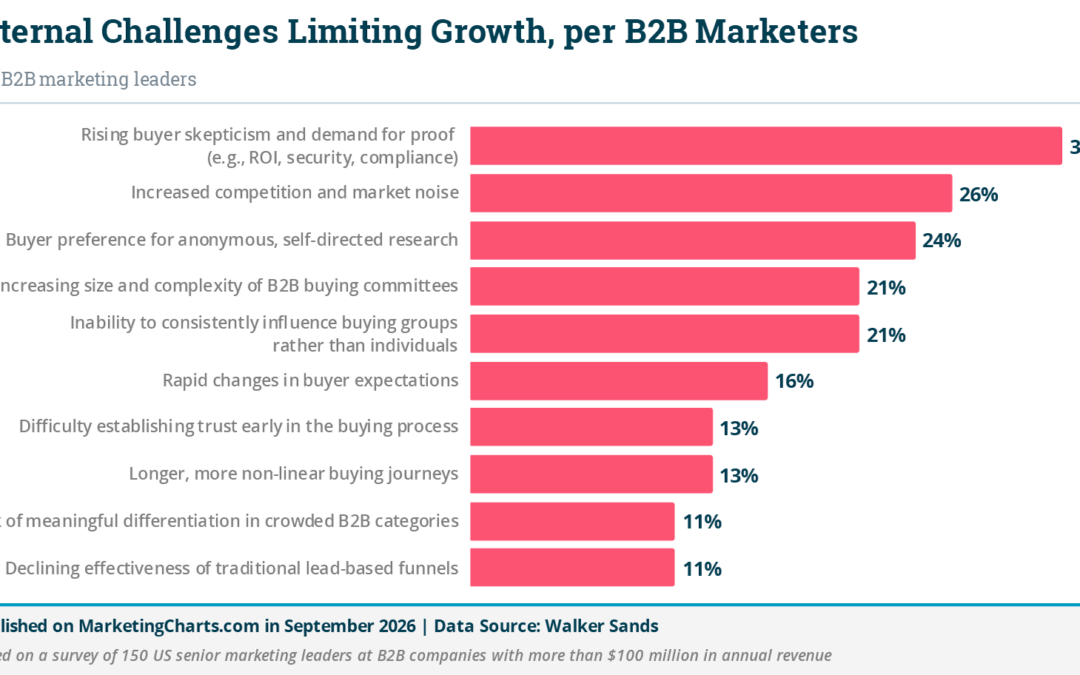
New research from Walker Sands shows a clear gap. Almost every B2B leader surveyed said they understand what modern marketing should look like. But 95% also said their marketing must improve to compete with leading brands. The fundamental issue isn’t a lack of activity; it’s a lack of integration.
Strategy must guide the work. Creative must make the strategy clear and useful. Execution must stay consistent. Measurement must show whether the work supports the business goal.
When every element of your marketing engine works in unison, it stops being a cost center and starts driving measurable financial outcomes:
- Lower Customer Acquisition Cost (CAC): Strategic alignment eliminates wasted spend on non-performing tactics and disconnected tools.
- Faster Pipeline Velocity: Consistent, compelling messaging across sales and marketing shortens complex B2B buying cycles.
- Higher Deal Win Rates: Clear, differentiated creative positioning protects margins against lower-cost competitors.
Disconnected Marketing vs. Connected Marketing
| Marketing Area |
Disconnected Approach |
Connected Approach |
| Content Strategy |
Produced for volume based on team assumptions. |
Built to solve specific buyer questions and needs identified by sales. |
| Technology & AI |
Mass produces generic assets across isolated tools. |
Scales approved positioning and accelerates personalized buyer journeys. |
| Measurement |
Focuses on clicks, opens, impressions. |
Focuses on marketing activity to business outcomes. |
| Sales Alignment |
Sales creates its own materials because existing content isn’t useful. |
Sales uses marketing materials to close deal conversations. |
Start with Strategy, Not Tactics
The Study reveals 67% of marketing leaders struggle to identify which business results executives expect them to impact, while 79% find it difficult to demonstrate marketing ROI altogether.
This gap creates a basic problem: you cannot measure marketing performance effectively if leadership hasn’t agreed on what marketing must achieve. This is why strategy must come before tactics. Before your launch another campaign, produce more content, redesign a website, or add a new tool, ask your team:
- What specific business problem must we solve?
- Which audience matters most right now?
- What must the audience understand and act on?
- Why should buyers choose us over the competition?
- Which marketing activities can produce the desired outcome?
- How will we measure success?
These questions help turn marketing from a list of tasks into a coordinated business function.
Many Problems Start Before Execution
B2B leaders identified five areas where their marketing needs to improve:
- Measurement and performance insights.
- Consistent marketing operations.
- Cross-channel coordination.
- Testing and validating new channels.
- Long-term brand building and awareness.
Notice what is not on this list. Leaders aren’t asking for more emails, higher content volume, or more social posts. Their challenges start much earlier. Companies need clear priorities, channels to support each other, distinct brand positioning, useful performance data, and operational systems that keep teams aligned.
These are strategy problems before they become production problems.
Strategy Is Not Enough
A good strategy can still fail if the execution gets ignored. In many B2B organizations, creative work is treated as a final design step. That narrow view misses its true value: creative strategy helps turn business goals into messages that people can understand, remember, and act on.
While strategy defines the target audience and value proposition, creative work communicates that value. For a B2B organization, strategic creative work can:
- Explain complex services in simple terms.
- Build a clear and consistent visual identity that builds immediate recognition.
- Turn product features into meaningful customer outcomes.
- Create campaigns that help sales teams start better conversations.
- Make complex information easier to compare.
- Show buyers why the company is different.
This work matters even more because AI can create functional content in seconds. While modern AI drastically speeds up asset production, it does not guarantee differentiation. True value comes from knowing what to say, why it matters, and how to communicate it clearly.
Brand and Demand Must Work Together
Companies often treat long-term brand building and short-term demand generation as competing priorities, when they should support each other. The data shows that B2B leaders recognize long-term brand building as an area that needs improvement. That matters because demand generation becomes harder when buyers do not know your company, understand your value, or see a clear difference between you and your competitors.
A connected strategy harmonizes brand and demand across every touchpoint. For example:
- Your website supports the same value proposition used by sales.
- Your thought leadership validates your expertise.
- Your email marketing matches the tone and authority of your social channels.
- Your sales materials continue the same message used in campaigns.
Connected marketing also requires feedback from sales. Sales teams hear buyer questions and objections directly. Marketing can use that information to improve strategy, content, and messaging.
AI Scales Good Marketing and Bad Marketing
B2B leaders also show strong interest in AI and marketing automation. AI can help with research, content drafting, data analysis, and repetitive tasks. But technology cannot fix a weak strategy.
- If your positioning is unclear, AI can create more unclear content.
- If your messaging is generic, AI can create more generic content.
- If teams do not agree on priorities, automation can help them move in different directions faster.
Before asking “What can we automate?” ask “What must we improve, and where can technology help?” First, get the direction, then use technology to scale the work.
Marketing Must Be Part of Growth Strategy
The research also shows a gap between expectations and involvement. 89% of B2B leaders expect marketing to help drive revenue. But only 45% said executive leaders view marketing as a core part of growth strategy. That creates a problem.
Companies expect marketing to support growth, but some still treat it mainly as a production function. Marketing should be involved earlier. It should help connect:
- Business goals and revenue targets.
- Buyer needs and pain points.
- Competitive positioning and messaging.
- Creative direction and sales enablement.
- Marketing channels and technology.
- Measurement frameworks and analytics.
When strategy and creative work together, business goals become easier to communicate and support through marketing. Strategy without strong creative can be difficult to see. Creative without strategy can attract attention without supporting the business goal. The strongest marketing connects both.
Quick Audit: Is Your Marketing Connected?
Ask your leadership team these three questions:
- Can everyone identify your top 3 marketing priorities?
- Does your primary sales presentation use the same core positioning as your website?
- Can your marketing reports connect key campaigns to qualified pipeline or revenue?
If the answers are not consistent, your marketing may have an alignment problem. That does not mean you need more tactics. It may mean the existing work needs to connect more clearly.
Your 30-Day Starting Point
Start with a simple review. Gather your:
- Website homepage.
- Main sales presentation.
- Latest email campaign.
Compare them side-by-side. If the positioning, tone, and value proposition don’t match, you have found your primary growth bottleneck.
Turn Disconnected Marketing Into Connected Marketing
Adding more tactics will not fix unclear priorities, inconsistent messaging, or disconnected channels.
BersonDeanStevens helps B2B companies connect strategy and creative execution so their marketing supports clear business goals. We help companies improve positioning, messaging, creative direction, content, campaigns, and marketing systems so the parts work together.
Is Your Marketing Working Together?
Schedule a complimentary call with Lori at lberson@bersondeanstevens.com or use her calendar to identify where your strategy, creative, or execution may need better alignment.
BersonDeanStevens (BDS) has developed creative, results-driven marketing strategies, content, campaigns, and programs for over 27 years – with AI incorporated where it adds efficiency and lifts results. Whether you need a fractional CMO, assistance for an overloaded team, or strategic counsel from time to time, BDS is your go-to resource. Client list.

by Lori Berson | Sep 15, 2026 | AI, Content Marketing, Creative Services, Design, Digital marketing, Marketing, Marketing Strategy
- Speed Is No Longer a Differentiating Advantage: As AI makes competent marketing instantaneous for everyone, output volume and speed lose their competitive edge. Value shifts from how fast you produce to how distinctly you position your message.
- AI Excels at Patterns; Human Strategy Requires Originality: AI generates content based on existing data, which leads competing brands into a generic “sea of sameness.” Creative strategy uncovers unique insights and distinct positions that competitors cannot easily replicate with the same prompts.
- Creativity Is a Strategic Asset, Not Aesthetic Polish: In complex industries like financial services and health insurance, strong creative strategy isn’t just visual design. Its primary job is to simplify intricate rules, clarify dense value propositions, and turn complex ideas into memorable messaging that drives sales.
- Constructive Pushback Protects Your Investment: AI blindly executes instructions regardless of their strategic value. Experienced creative partners interrogate the brief, eliminate clutter, and prevent brands from spending resources on polished work that fails to address the root business problem.
- The Winning Formula Balances AI Efficiency with Human Judgment: High-performing marketing teams use AI to accelerate research, organize data, and streamline execution—while reserving strategy, brand voice, empathy, and creative direction for human talent.
AI has made marketing faster and easier to produce. Almost any business can now generate headlines, images, emails, presentations, videos, and campaign ideas in minutes. While AI shifts output into overdrive, it presents a double-edged sword: when every brand uses the same toolset, speed alone ceases to be a competitive advantage. In fact, the opposite is true. As AI makes it easier to produce competent marketing, distinctive creative thinking becomes exponentially more valuable.
We are already surrounded by copycat collateral like identical headlines, mirrored site layouts, generic illustrations, and recycled buzzwords like “transformation,” “growth,” and “customer experience.” The work may look polished, but much of it is easy to forget. Creativity is not a decorative layer applied after the strategy is complete; it is a strategic business asset.
AI Can Create More. It Does Not Guarantee Differentiation.
While I actively use and advocate for AI tools to accelerate research, organize information, analyze data, and streamline production, output is not strategy. As analyst Brian Solis highlights, AI extends human capability, but human creativity remains the sole engine for creating memorable, meaningful brand experiences.
That distinction matters. AI excels at identifying and repeating patterns based on existing data. Creative strategy asks a fundamentally different question: What should we create that is different, useful, and right for this specific audience? That might mean finding a simpler way to explain a complicated financial product, crafting a campaign competitors haven’t considered, or turning a dense carrier announcement into something brokers can quickly digest and act on. AI can support that work, but the strategic thinking behind it cannot be outsourced.
The Bigger Risk Is Forgettable Marketing
AI-generated marketing is rarely bad; in fact, it’s often perfectly adequate. That adequacy is precisely the risk. If competing companies use AI to research the same audiences, analyze the same competitors, and follow the same content structures, their brand messaging inevitably gravitates toward the middle.
Professional creative work must move in the opposite direction, carving out a distinct message, visual style, and point of view that a company can truly own. As Marketing-Interactive recently noted, there is a growing demand for creative leaders who can help brands stand out in a growing “sea of sameness.” AI provides speed and scale, but people supply the judgment, empathy, insight, and original thinking required to make an impact. The question is no longer just, “Can AI create this?” A far better question is: What can our brand create that a competitor cannot easily reproduce with the same tools?
Creativity Has a Business Job
Creative services are too often mischaracterized as an aesthetic expense, a tool to make a brochure look nicer, a presentation cleaner, or a campaign more attractive. Those are mere outputs. The real job of creative work is to help a business communicate clearly and compete aggressively.
Strong creative strategy transforms complex ideas into intuitive messaging that earns attention, builds credibility, supports sales, and reinforces brand value. It makes similar products feel meaningfully different, an essential capability in heavily regulated industries like health insurance and financial services. These sectors contend with technical products, intricate compliance rules, homogeneous competitors, long sales cycles, and high trust barriers. When faced with these challenges, more information is rarely the answer; better, clearer communication is.
Creative Strategy Makes Complex Information Useful
Consider a General Agency communicating a major carrier change. The source documentation often spans network updates, benefits, eligibility requirements, and broker deadlines. The creative challenge isn’t just making those documents visually appealing; it’s deciding what the broker needs to know first, what changed, who is affected, and what to do next. That is strategy expressed through design and content.
Financial services face the same obstacle. An asset-based lender, wealth management firm, or RIA may possess deep expertise yet sound indistinguishable from competitors by relying on tired phrases like “customized solutions,” “trusted partner,” or “decades of experience.” While true, these claims are easy for anyone to make. Creative strategy digs deeper to uncover why clients truly choose your firm, what unique market friction you solve, and how to translate those answers into memorable marketing that drives decision-making.
Good Creative Partners Do More Than Execute
Experienced creative partners deliver an indispensable asset that AI cannot replicate: constructive pushback. Strategic creators do not simply execute requests blindly; they interrogate the work to protect your investment.
They ask the hard questions: Does this headline actually say anything? Does the site focus on the customer or the company? Are we cramming six messages into a campaign when the audience will only remember one? Sometimes the most valuable creative contribution is recognizing that the initial request won’t solve the underlying problem, saving businesses from spending money on polished work that fails to move the needle.
How I Approach Creative Work at BersonDeanStevens
At BersonDeanStevens, I unite strategy, creativity, and technology into a cohesive workflow. Every project begins with the core business problem: understanding who we are targeting, what drives their decisions, what prevents them from acting, and what distinct positioning your company can credibly own.
Only after defining the strategy do we craft the execution, whether through brand positioning, integrated campaigns, interactive tools, web design, thought leadership, or AI-assisted marketing workflows. AI speeds up execution, but speed only helps when moving in the right direction. The underlying strategy and brand voice must remain solid.
Test Your Marketing for Sameness
Before publishing your next AI-supported campaign, evaluate your content against these quick criteria:
- The Logo Swap: Could a direct competitor put their logo on this piece and publish it without changing a word?
- Specific Value: Are you delivering a specific, actionable insight or repeating standard industry jargon?
- Brand Voice: Does the tone, style, and visuals uniquely reflect your company’s identity?
- Clarity & Memory: Does the execution clarify a complex idea and give the audience a compelling reason to remember it?
If these questions highlight a gap, generating more content will only amplify the issue. Fix the underlying strategy first.
Grab the AI-Era Creative Partner Checklist to evaluate your current agency or internal workflow against 8 critical differentiation standards.
Efficiency Is Easier to Buy. Originality Is Not.
As AI tools mature, production costs will drop, output speeds will rise, and smaller teams will produce larger volumes of content. However, when everyone can produce polished work instantaneously, volume and polish lose their premium value. Competitive advantage shifts from who can create more to who can determine which ideas are worth pursuing.
Businesses do not need to choose between AI efficiency and human creativity. The most successful organizations leverage AI to automate research, analyze data, and streamline production, while relying on experienced human talent for strategy, judgment, and original direction.
If your marketing is starting to blend in, contact BersonDeanStevens to discuss how strategic positioning and distinct creative execution can give your brand an unmistakable edge.
To get started, contact Lori at lberson@bersondeanstevens.com or schedule a complimentary call.
BersonDeanStevens (BDS) has developed creative, results-driven marketing strategies, content, campaigns, and programs for over 27 years – with AI incorporated where it adds efficiency and lifts results. Whether you need a fractional CMO, assistance for an overloaded team, or strategic counsel from time to time, BDS is your go-to resource. Client list.
by Lori Berson | Sep 5, 2026 | AI, Digital marketing, Marketing, Marketing Strategy
Key Takeaways
- Most competitive research tells you what already happened. The real value comes from understanding what those changes mean for your business.
- Focus on three questions: What does this mean for us? Where are we exposed? Where is the opening?
- Use AI for repetitive monitoring, such as tracking messaging, pricing, sentiment, content, and positioning changes.
- Use people for interpretation, strategy, judgment, and deciding what to do next.
- You do not need a large technology stack. Start with simple monitoring tools and use AI to help analyze what you find.
- Do not ask AI only for summaries. Ask specific questions that lead to decisions and actions.
- The advantage is not simply faster competitive reports. It is turning competitor data into better recommendations and better decisions.
- Access to AI is no longer the differentiator. Knowing what to ask and how to act on the answers is.
Somewhere in your marketing files, you probably have a competitor tracking document. Maybe it is a dashboard. Maybe it is a weekly report that someone updates every Friday.
It feels organized. It feels like you are staying on top of things. But much of that information tells you what already happened.
That is the problem I see with most competitive research.
Watching a competitor and understanding what their actions mean are two different jobs. Most teams focus on the first one.
Social listening tools count mentions and measure sentiment. Weekly reports summarize recent activity. Those tools can be useful, but they usually look backward. They tell you what changed. They do not always tell you what is shifting, what might happen next, or what any of it means for your business.
AI is starting to change that.
The Three Questions That Actually Matter
I have watched companies treat competitive research like a homework assignment for years. They collect the data. They organize it into a presentation. They discuss it in a meeting. Then the report gets filed, and very little changes.
Tracking competitors is the easy part.
The work that can actually move a business happens when I ask three questions:
- What does this mean for us?
- Where are we exposed?
- Where is the opening?
Everything else is data collection.
If a competitive report does not help answer those questions, I do not think it is doing enough. You have information, but you do not yet have strategy.
This is where I think AI genuinely earns its place in the process.
AI is good at the repetitive monitoring. It can watch for changes in messaging. It can track sentiment across reviews and online discussions. It can identify when a competitor changes its content, pricing, positioning, offers, or priorities.
An experienced analyst can closely track one or two competitors. AI can help monitor many more sources, every day, without the same limits on time and attention. That matters because it gives people more time to focus on the work that requires judgment.
I can spend less time gathering information and more time asking:
- What does this mean?
- Where are we vulnerable?
- What should we do next?
Two Tools, Not Twenty
I don’t think you need a stack of twelve platforms to do this well. You only need two things: a way to watch and a way to think.
Watching means monitoring.
There are dedicated competitive intelligence tools for this. Some enterprise platforms can cost tens of thousands of dollars a year. Most companies do not need to start there.
You can build a lean version yourself.
Set Google Alerts for competitors and their leadership teams. Use a traffic analysis tool to monitor their websites. Review customer comments and reviews. Collect important observations in one shared document each week. It is partly manual, but it works.
Thinking means synthesis.
This is where I use an AI model such as Claude. I can give it a week of observations and ask the three questions, one at a time.
I do not ask: “Tell me about this competitor.”
That usually gives me a summary.
Instead, I ask: “What does this mean for us?”
Then I push further.
If the answer is too general, I ask for the evidence behind it. I ask what action the company should take. I ask what I would actually do differently on Monday because of what the model found.
That is when the analysis gets more useful.
AI Raises the Baseline. It Does Not Do the Thinking for You.
This is the part I think gets lost in much of the AI discussion.
The value is not simply faster reports. The real value is better thinking.
Teams can spend less time collecting and organizing information and more time walking into leadership meetings with recommendations instead of recaps.
But that only works if a person is still doing the interpreting.
AI can tell me that a competitor changed its pricing page. It cannot decide by itself whether that change should worry me, whether it matters at all, or whether it creates an opportunity elsewhere.
That is strategy. That is judgment. That still belongs to people.
Every company now has access to many of the same AI tools. Fewer companies have people who know which questions to ask and how to act on the answers.
If you want a second set of eyes on what your competitors’ moves actually mean, I am always open to that conversation. No pitch. Just a practical discussion about what is changing, where you may be exposed, and where there may be an opening.
Your competitors may already be using AI to study your next move.
The real question is whether you are using it to study theirs, or still waiting for Friday’s report to tell you what already happened.
For help turning competitor activity into practical insights and next steps, reach Lori at lberson@bersondeanstevens.com or schedule a complimentary call.
BersonDeanStevens (BDS) has developed creative, results-driven marketing strategies, content, campaigns, and programs for over 27 years – with AI incorporated where it adds efficiency and lifts results. Whether you need a fractional CMO, assistance for an overloaded team, or strategic counsel from time to time, BDS is your go-to resource. Client list.

by Lori Berson | Feb 20, 2024 | Digital marketing, Lead Generation, Marketing, Marketing Strategy
According to the study by Integrate Pipeline360 and Demand Metric, B2B marketers are increasingly relying on paid social media and email marketing to generate leads, reflecting a strategic shift towards digital channels that offer measurable results and targeted outreach. This focus is driven by the dual objectives of improving lead quality and increasing lead volume, challenges that are top of mind for marketers aiming to enhance their sales pipeline and drive business growth.
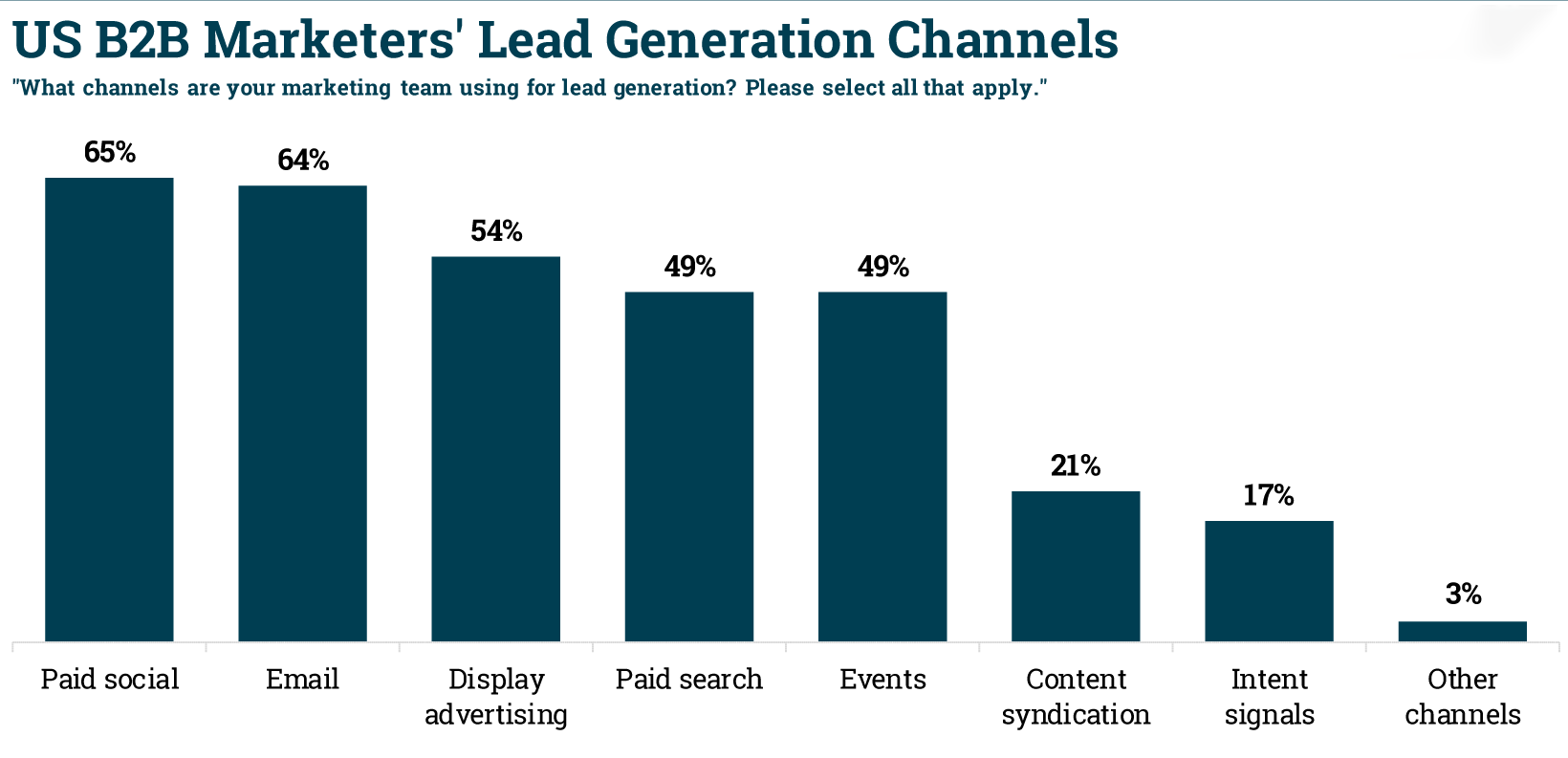
However, the quest for more leads doesn’t always end with choosing the right channels. It extends into optimizing these channels to ensure that the leads generated are not only numerous but also of high quality. This is where the complexity of digital marketing becomes evident, as marketers must navigate the nuances of content creation, audience targeting, and data analysis to achieve their lead generation goals effectively.
For companies looking to navigate the complexities of lead generation in this digital age, BersonDeanStevens, Inc. (BDS) offers expertise in crafting and executing lead generation strategies that are tailored to the unique needs of B2B marketers. With a deep understanding of digital marketing trends and the challenges faced by marketers today, BDS is positioned to help businesses enhance their lead generation efforts, ensuring a steady flow of high-quality leads. For those looking to elevate their lead generation strategies and drive meaningful business results, contact BDS for expert guidance and support.
About the Data: The results are based on a November 2023 survey of 437 marketers in the US (50% share) and UK (46%) working at companies targeting B2B (58%) or B2B and B2C (42%) channels.
For help with your lead generation, schedule a call or email Lori Berson at lberson@BersonDeanStevens.com.
BersonDeanStevens has been a recognized brand strategy and marketing leader for over 25 years. We work in partnership with you to differentiate your brand and achieve your business goals. Client list.

by Lori Berson | May 10, 2022 | Digital marketing, Marketing, marketing technology
Overview
With pandemic shutdowns, the ‘great resignation’ (leading to millions of start-ups*), supply chain disruptions, and increasing inflation, it’s been tough to bring in new business.
We’ve seen many small businesses, professionals, and independent contractors struggling to either jumpstart sagging sales or get a new business off the ground. Many have considered hiring a marketing agency, a marketing consultant, or adding to staff but that can be expensive when budgets are tight and talent is limited. In looking for a way to help the business community that has been so good to us over the years, we came up with the idea to write ‘Ready-Made Marketing.’
Take the guesswork out of marketing.
Designed to help people succeed, the book is a quick and easy DIY marketing resource that enables those who don’t have marketing expertise (or the money to hire it) to market themselves, their services or their businesses and start seeing immediate results. Ready-Made Marketing is not about writing marketing plans or strategies; it provides practical, customizable templates for a variety of business-building situations, step-by-step instructions for using proven and effective marketing tactics, and over 400 technology resources that are affordably priced or free.
Abbreviate what you have to do to lighten your workload.
The book is action-oriented; it’s not a novel to read through nor does it require a major time commitment. For example, if you need to write a cold email, you can choose from a variety of templates or if you need a video script, you just go in and pick one. Or if you need a technology resource (e.g. video recording software, content creation tools, podcast hosting, among others) you can select from 21 categories or use the authors’ choices.
Whether you’re starting a new business, want to increase revenue for your current business, or know of someone who needs to jumpstart sales, this book is a game-changer.
To make 2022 a better year, check out Ready-Made Marketing.
*According to the U.S. Census Bureau:
- In 2020, there were more than 4.4 million new businesses; the highest total on record.
- This is a 24.3% increase from 2019; 51.0% higher than the 2010-2019 average.
- ½ million new businesses were started in January 2021 alone.
BersonDeanStevens has been a recognized brand strategy and marketing leader for over 25 years, including over a decade in marketing and sales automation. We work in partnership with you to differentiate your brand and achieve your business goals. Client list.
