by Lori Berson | Aug 12, 2026 | AI, artificial intelligence, Marketing, marketing technology
Key Takeaways
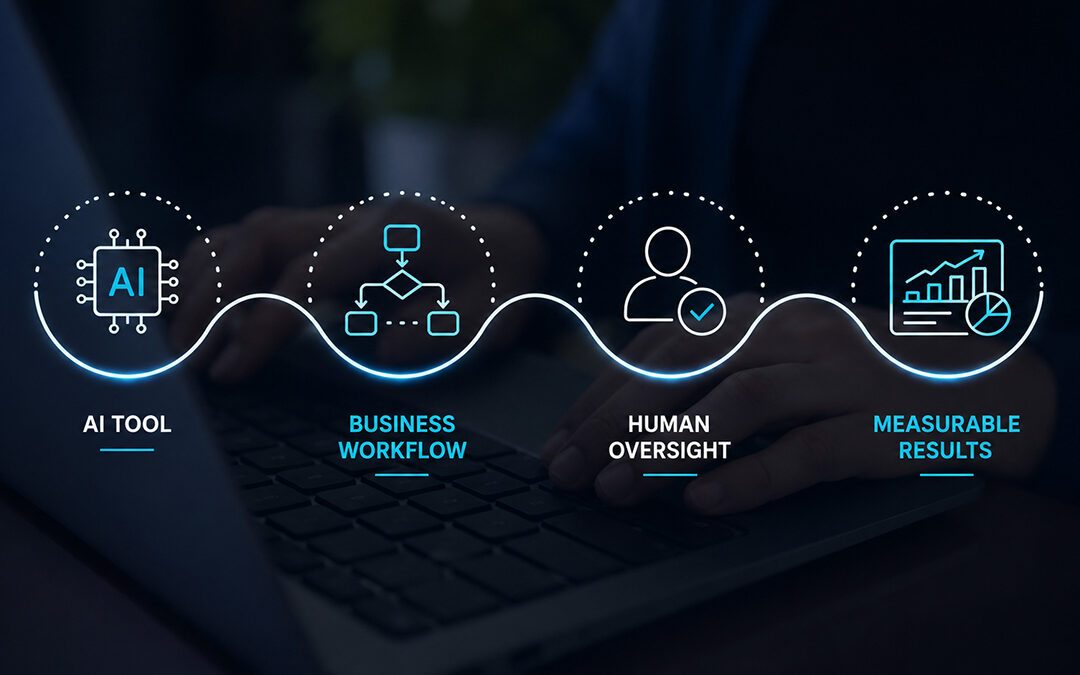
- AI use is already widespread in marketing and is growing quickly among organizations. Individual AI productivity is far more common than true workflow automation.
- The best starting point is a business bottleneck, not an AI tool.
- Poor processes should be fixed before they are automated.
- AI performance depends on good data, clear rules, ownership, training, and human review.
- Not every task should be automated.
- Start with one high-value, manageable workflow.
- Establish a baseline, measure the outcome, and expand only after the workflow proves useful.
- The long-term advantage will not come from access to AI. It will come from how well the company applies it.
AI adoption is no longer the issue I’m most concerned about. What concerns me is how many companies are using AI without knowing whether it is actually improving the business.
Employees are drafting emails, researching competitors, summarizing meetings, creating content, analyzing information, and experimenting with AI features inside the software they already use. That is progress.
But there is a big difference between using AI and building a better business with AI.
Recent research shows that AI adoption is already widespread. Salesforce’s global survey of 4,850 marketing decision-makers found that 75% of marketing organizations were either experimenting with or had fully implemented AI. High-performing marketing teams were 2.5 times more likely than underperforming teams to have fully integrated it.
A government census revealed small businesses are moving in the same direction. SMB AI use shows that employees are increasingly using AI for writing, research, marketing, customer-facing work, and recurring administrative tasks. Yet according to the U.S. Chamber of Commerce Foundation 2026 study, only 6% of small-business workers report using AI to automate workflows with minimal human involvement.
That is the gap I think business leaders should be paying attention to.
The next stage of AI is not getting employees to try it. It is about figuring out where AI can improve how the company actually works.
Using AI Is Not the Same as Integrating AI
Most companies did not begin using AI with a formal strategy. Someone started using ChatGPT. Someone else began using an AI feature inside HubSpot, Salesforce, Microsoft, Adobe, Google, or another platform.
Marketing used it to create content. Sales used it for research and follow-up. Employees began using it to summarize meetings, review documents, or brainstorm ideas. That experimentation has value. It helps people learn what AI can and cannot do. But experimentation eventually reaches a limit.
The U.S. Chamber of Commerce research illustrates that clearly. Among small-business workers using AI, 64% primarily use it for individual productivity, while only 6% use it for workflow automation with minimal human involvement.
The SMB research illustrates that clearly. Among small-business workers using AI, 64% primarily use it for individual productivity, while only 6% use it for workflow automation with minimal human involvement.
Marketing shows the same pattern. AI is now being used for content optimization, content creation, ideation, workflow automation, social strategy, data analysis, and personalization. But implementation maturity, data quality, training, governance, and trust remain significant barriers.
That tells me: The technology is becoming easier. The business application is still the hard part.
Start With the Bottleneck, Not the AI Tool
When business leaders talk to me about AI, the conversation often begins with software.
- Should we use ChatGPT or Claude?
- Do we need AI agents?
- What can we automate?
- Should we connect AI to our CRM?
Those are reasonable questions. But they are usually not the first questions I would ask.
A better starting point: Where is your company losing time, money, accuracy, responsiveness, or opportunity today?
AI is most useful when it solves an existing business problem. For example, a marketing team might be spending too much time:
- Creating versions of similar emails or campaigns.
- Searching for information across documents and systems.
- Repurposing content.
- Preparing campaign reports.
- Updating CRM records.
- Reviewing work for errors or missing information.
- Researching prospects or competitors.
- Following up after meetings.
- Answering the same internal questions repeatedly.
Those are not AI problems. They are business problems that AI may be able to help solve. That distinction matters because companies sometimes buy an AI tool first and then search for a reason to use it.
I recommend doing the opposite. Find the friction first.
Why Companies Get Stuck
The research points to several reasons why businesses struggle to move from experimentation to measurable results.
1. Employees Know How to Use AI, But Not How to Use It Effectively.
Marketers are already using AI, but training has not kept pace. The research shows that 67% of marketers cite a lack of training as a barrier to AI adoption. Other barriers include a lack of AI strategy, skills, ownership, and governance.
This is why I do not think another general “how to prompt ChatGPT” seminar is enough. Employees need training tied to their actual work.
- A marketer needs to understand how AI can support campaign development, content review, segmentation, analysis, and reporting.
- A salesperson may need help with prospect research, follow-up, proposal preparation, and CRM updates.
- A business leader needs to understand prioritization, ROI, risk, implementation, and where human oversight is required.
The real question is not: How do we teach people to use AI?
It is: How should AI change the way this job gets done?
2. Companies Try to Automate Processes That Are Already Unclear
This is one of the biggest mistakes I see.
If a workflow is inconsistent before AI, automation can simply make the inconsistency happen faster.
Consider lead follow-up. Before automating it, the company needs to define:
- What makes a lead qualified?
- Who owns the lead?
- How quickly should someone respond?
- What information is required?
- What happens when information is missing?
- When does a person need to intervene?
- What counts as a completed handoff?
If those questions do not have clear answers, AI will not solve the problem.
The SMB research supports this. Reliable workflow automation requires standardized processes, connected systems, usable data, ownership, testing, and ongoing maintenance. In other words: Do not automate a bad process. Fix the process first.
3. AI Can Only Work with The Information You Give It
This issue becomes especially important in marketing.
AI can help personalize customer communications. But it needs accurate customer information.
It can analyze CRM data. But poor CRM data will produce poor analysis.
It can answer questions from company documents. But only if those documents are current, approved, and accessible.
It can create content quickly. But speed does not help if the content sounds generic, makes unsupported claims, or does not reflect your brand.
Research on marketing AI adoption points to this same problem. Marketers are using AI for increasingly sophisticated applications, but data readiness and trust continue to limit what companies can do with it.
AI implementation is not just a technology project. It is also a data, process, and management project.
4. Nobody Owns The Outcome
Individual AI adoption often happens from the bottom up. Employees discover a tool and begin using it. That’s easy.
Operational AI requires someone to take responsibility for the result. Leadership needs to decide:
- Which AI opportunities are worth pursuing.
- Which tools are approved.
- What information employees can use.
- Where human review is required.
- What success looks like.
- Who owns the workflow.
- How results will be measured.
- When a workflow should be expanded or stopped.
Without that structure, companies can end up with plenty of AI activity but very little business improvement.
The Goal Should Not Be to Automate Everything
There is a lot of pressure right now to automate as much as possible. I think that is the wrong objective. The better question is:
Which parts of the work should AI handle, and which parts become more valuable when people handle them?
AI is especially useful for repetitive, information-heavy, and data-driven work. It can:
- Review large amounts of information.
- Generate first drafts.
- Summarize content.
- Compare documents.
- Find patterns.
- Categorize information.
- Execute well-defined steps quickly.
- Assist with analysis and decision support.
Humans remain essential for strategy, judgment, creativity, context, relationships, accountability, and decisions where the consequences matter. That balance has been central to how I think about AI.
I have used the idea of treating AI almost like an additional FTE. But I think there is an important condition attached to that idea. An AI “employee” still needs a job description, approved information, processes, supervision, quality standards, and performance measures.
You would not hire an employee, give that person access to everything, provide no training, establish no procedures, and assume productivity would improve. Yet that is close to how some companies are approaching AI.
Don’t Boil The Ocean, Start With One Workflow
I recommend choosing one workflow where there is a clear business problem. Then work through these questions.
What happens today?
Document the current process. Do not assume everyone follows the same steps.
Where is the friction?
Look for:
- Repetitive work.
- Delays.
- Errors.
- Rework.
- Poor access to information.
- Inconsistent follow-up.
- Unnecessary manual steps.
- Bottlenecks that depend on one person.
What should improve?
Define the outcome before selecting the technology. That might mean:
- Reducing a four-hour task to one hour.
- Shortening response time.
- Improving accuracy.
- Reducing repetitive work.
- Increasing follow-up consistency.
- Launching campaigns faster.
- Giving employees more time for higher-value work.
Which steps could AI assist with?
Not every part of the workflow needs AI. Sometimes conventional automation is better. Sometimes the process simply needs to be redesigned.
Where is human judgment required?
Create deliberate checkpoints for review and approval. Human oversight should not be an afterthought.
How will you measure the result?
Establish a baseline before making the change. For marketing, that might include:
- Production time.
- Campaign launch time.
- Conversion.
- Engagement.
- Cost per lead.
- Pipeline contribution.
- Errors and corrections.
- Rework.
For operational workflows, measures might include:
- Time saved.
- Turnaround time.
- Error rate.
- Customer response time.
- Employee capacity.
- Accuracy.
This Is Why I Start With an AI Assessment
The BersonDeanStevens AI Opportunity Assessment begins with the business rather than the software.
The assessment reviews goals, systems, workflows, constraints, data handling, risk, employee adoption, and opportunities to improve efficiency, accuracy, access to information, and service. Opportunities are then prioritized based on business impact, implementation effort, risk, and readiness.
The result is a practical roadmap that helps answer four questions:
- Where can AI deliver value?
- What should we prioritize?
- What should remain under human control?
- How will we know if it worked?
That is a much more useful outcome than a long list of AI tools.
Assessment Is Only the Beginning
Knowing what to do does not mean it will get done. I think this is going to become one of the larger AI challenges for organizations.
A management team can identify ten good AI ideas in one meeting. That does not mean the business should attempt all ten.
I recommend selecting one high-value, manageable workflow, then building, testing, measuring, and refining it before moving to the next one. That is the thinking behind the BDS AI Concierge Service.
The AI Concierge Service provides hands-on support to select, build, test, implement, and improve one priority AI-assisted workflow at a time. The service includes working sessions, custom workflows, documentation, support, performance measures, and ongoing guidance on where to focus next.
The objective is not simply to make people better at using AI. It is to build a growing set of repeatable workflows that improve the business.
Access to AI Will Not Be the Competitive Advantage
This is the point I think many companies are missing. Your competitors have access to the same AI models you do. They can buy many of the same platforms. Their employees can use many of the same tools. AI itself is becoming widely available. So access is unlikely to remain a meaningful competitive advantage.
A company that improves its processes, organizes its knowledge, cleans up its data, trains employees, establishes safeguards, and deliberately incorporates AI into high-value work can become faster, more consistent, and more capable.
A company that simply gives everyone an AI account may produce more work without producing better results. That is the distinction I would focus on now.
The first stage of AI adoption was experimentation. The next stage is operationalization. And that takes more than a prompt.
For help turning AI opportunities into practical workflows and measurable business results, reach Lori at lberson@bersondeanstevens.com or schedule a complimentary call.
BersonDeanStevens (BDS) has developed creative, results-driven marketing strategies, content, campaigns, and programs for over 27 years – with AI incorporated where it adds efficiency and lifts results. Whether you need a fractional CMO, assistance for an overloaded team, or strategic counsel from time to time, BDS is your go-to resource. Client list.
by Lori Berson | May 13, 2026 | AI, artificial intelligence, Content Marketing, Creative Services, Marketing, Marketing Strategy, marketing technology
Key Takeaways
- AI without strategy is just faster mediocrity.
- Bolting AI onto broken workflows doesn’t fix them, it makes the friction faster.
- Three systems deliver the highest ROI: content pipelines, digital workers, and intelligent lead management.
- The results are documented real client outcomes, not vendor estimates.
- Strategy and creative are now your scarcest assets. Anyone can automate.
- The right AI-integrated marketing pays for itself typically within one to three quarters.
Most companies are aware that AI should be integrated into their marketing. The gap isn’t knowledge, it’s execution. Knowing AI matters and building the systems that prove it are two very different things.
Eighty-eight percent of companies use AI. Only 12% of CEOs see it move the bottom line (McKinsey’s The state of AI report). That’s not a technology problem. It’s a strategy and systems problem, and it’s exactly what BDS helps solve.
Why Bolting AI onto Old Workflows Doesn’t Work
If your team adopted an AI writing tool but still routes approvals by email, formats assets by hand, and publishes manually, you’ve sped up one step in a broken process. The friction is still there. You’ve just reached it faster.
Real integration starts with strategy: knowing which workflows to redesign and which creative approaches will actually differentiate you. BDS brings all three: the strategic direction, creative execution, and the automated systems that deliver both at scale.
Three BDS Systems That Deliver Measurable ROI
- Content Production and Repurposing Pipelines. One asset becomes many, but only when the creative strategy behind it is sharp. BDS develops the messaging and content direction first, then builds the pipeline that turns a single client conversation into an email campaign, five LinkedIn posts, a blog, and a one-sheet. Strategic thinking happens once. Distribution happens automatically.
- Digital Workers. Repeatable tasks, data extraction, CRM updates, document formatting, and plan comparisons are assigned to automated systems that run the same way every time. BDS has cut insurance document analysis from 3 days to 12 minutes. Salesforce data analysis from 2 weeks to 50 minutes. These are live client results.
- Intelligent Lead Management. Systems that track behavior, surface the right content at the right moment, and tell your team exactly who to follow up with and when. BDS designs both the creative assets that move prospects through the funnel and the automated logic that delivers them. Less guessing. More pipeline.
|
Real Results: BDS Client Engagements
Actual before-and-after times from client workflows.
|
| Use Case |
Before |
With AI |
Savings |
| Podcast Production (6-episode series) |
4 days |
6 hrs 21 min |
~94% |
| Multi-Channel Content Repurposing |
3 days |
2 hrs 14 min |
~94% |
| Video Tutorial Creation |
2 weeks |
7 hrs 30 min |
~94% |
| New Business Pitch Deck |
4 days |
3 hrs 20 min |
~92% |
| Insurance Document Analysis |
3 days |
12 min |
~99% |
| Email Campaign from Sales Conversations |
4 days |
5 hrs 48 min |
~85% |
| Insurance Workflow Optimization |
1.5 weeks |
2 hrs 15 min |
~97% |
| Salesforce Data Analysis |
2 weeks |
50 min |
~99% |
| The takeaway: Campaigns that once took weeks and cost $25,000–$75,000 now run in hours for under $5,000 for companies that have rebuilt their workflows around AI (The AI Transformation of B2B Go-to-Market Strategy report). |
Strategy and Creative Are the Differentiators. Systems Are the Delivery Mechanism
AI gave everyone the ability to produce average content instantly. More output is no longer an edge. What separates the winners is the strategy and creativity behind the tools, and most companies are missing one or both.
That’s where we come in. We develop the brand positioning, the messaging architecture, and the creative direction that make the content worth producing. Then we build the systems that produce and distribute it at scale. Strategy without systems stalls. Systems without strategy just move faster in the wrong direction. BDS provides both under one roof.
The marketing we build pays for itself typically within one to three quarters. And it keeps delivering long after the engagement ends.
Want to See Your Numbers?
BDS will build you a custom Digital Worker Opportunity Report, a specific, quantified assessment of what AI integration could deliver for your business, based on your actual workflows and economics. No generic frameworks. Your operations, your opportunity.
You can reach Lori at lberson@bersondeanstevens.com or book a 15 minute call — no pitch, no pressure, just a conversation about what you need.
BersonDeanStevens (BDS) has developed creative, results-driven marketing strategies, content, campaigns, and programs for over 25 years. We also incorporate AI where it adds efficiency and lifts results. Whether you need a fractional CMO, assistance for an overloaded team, or need consulting from time to time, BDS is your go-to resource. Client list.
by Lori Berson | Mar 23, 2026 | AI, artificial intelligence, Marketing, Marketing Strategy, marketing technology
Key Takeaways
- Most companies are using AI wrong. Experimenting with it is not the same as integrating it. One feels like progress. Only the other actually is.
- The 88% problem is real. Nearly 9 in 10 companies use AI, but only 1 in 10 sees it move the bottom line. Adoption without integration is just expensive dabbling.
- Bolting AI onto broken processes doesn’t fix them. If your team writes faster but still pushes data around by hand, you’ve sped up the problem, not solved it.
- Your competitors are cutting costs while you’re still paying. Campaigns that once cost $25K–$75K and took weeks now cost under $5K and run in hours…for companies that rebuilt their workflows, not just their tools.
- More content isn’t the answer anymore. Everyone can produce average content instantly now. Volume stopped being an advantage the moment AI became mainstream.
- AI follows strategy. It doesn’t replace it. Without a clear creative direction, you’re not moving faster toward your goal; you’re just moving faster.
- The cost of waiting is calculable. This isn’t a gut feeling. There’s a real number attached to every quarter you delay, and it compounds.
- Your marketing should pay for itself. The right AI-integrated workflows typically deliver ROI within one to three quarters, and keep delivering long after the work is done.
Your competitors aren’t waiting for permission.
While you’re running another quarterly planning session, they’re rebuilding. Not tweaking – rebuilding. The gap between companies that have integrated AI into their core operations and those still treating it as a productivity add-on isn’t widening gradually. It’s accelerating.
And the difficult truth? The biggest risk in your marketing program right now isn’t a failed campaign. It’s doing nothing.
The Pilot Purgatory Trap
Most organizations have tried AI. Brainstorming tools, email drafts, and meeting summaries. The early wins felt promising. Then progress stalled.
Here’s why: 88% of companies use AI, but only 12% of CEOs report actual bottom-line results. Getting just enough value to feel momentum, without transforming how work gets done, is pilot purgatory. You’re moving, but you’re not going anywhere.
To generate savings, AI needs to fundamentally change how work flows through your organization. If your team writes faster but still manually moves data between your CRM and email platform, you’ve optimized the symptom and ignored the disease.
The Efficiency Gap Is Compounding
Your competitors aren’t just moving faster. They’re operating at a different cost structure entirely.
Campaigns that once took weeks and cost $25,000–$75,000 now run in hours for under $5,000 for companies that have rebuilt their workflows around AI (The AI Transformation of B2B Go-to-Market Strategy report), not bolted AI onto their old ones. Every quarter you delay, that gap compounds. Not linearly. Exponentially.
The companies winning right now unified their tools, their data, and their teams into one system. They didn’t add more software. They eliminated the friction between what they already had.
Volume Is No Longer an Advantage
AI gives everyone the ability to produce average content instantly. In a market flooded with polished but soulless output, more content isn’t the edge; it’s the noise.
This is the paradox: the same technology creating the sameness problem is also your solution to it. But only if your strategy leads. AI amplifies, it doesn’t originate. Without a sharp creative direction guiding your tools, you’re just accelerating in the wrong direction, faster.
Authenticity, voice, and genuine strategic clarity are now your scarcest assets.
What’s This Actually Costing You? (Calculate It.)
The cost of inaction isn’t abstract. It’s measurable, and it’s likely larger than you think. Here’s a practical framework to quantify what you’re giving up each year:
1. Identify your highest-value AI use cases. Map three to five workflows where AI delivers proven results: content production, lead scoring, campaign reporting, sales enablement, or customer segmentation.
2. Benchmark your current baseline. For each workflow, measure time per task, fully-loaded cost per hour, error rate, and monthly volume. Be honest. Those numbers are your starting point.
3. Apply realistic AI uplift estimates. Use industry benchmarks, not best-case vendor projections. Typical ranges: 40–70% time reduction, 60–90% error reduction, 2–5x throughput increase.
4. Model three adoption timelines. Start now. Delay 12 months. Delay 24 months. Project outcomes across three to five years.
5. Calculate your one-year cost of inaction (CoI).
CoI = (AI savings + AI revenue uplift + risk costs avoided) − implementation cost
That number is what you’re voluntarily leaving on the table every year you wait.
6. Adjust for competitive exposure. Factor in competitor adoption rates, regulatory risk, and brand erosion from generic content. The cost of inaction isn’t just efficiency loss. It’s market share.
What Real Integration Looks Like
The window is open. Strategy and creativity are the only real differentiators left, and most of your competitors haven’t figured that out yet.
BersonDeanStevens combines 27 years of cross-industry marketing experience with AI-native workflow design. We don’t hand you a strategy deck and disappear. We build the systems, eliminate the manual work, compress your production timelines, and expand your team’s capacity…without adding headcount.
The marketing we build pays for itself. Typically, within one to three quarters. And it keeps running and delivering revenue long after our engagement ends.
Ready to see your numbers?
We’ll build you a custom Digital Worker Opportunity Report. A specific, quantified assessment of what AI integration could deliver for your business, based on your actual workflows and economics. Your numbers, your operations, your opportunity.
Schedule a brief call with Lori or reach her directly at lberson@BersonDeanStevens.com to get started today!
BersonDeanStevens (BDS) has developed creative, results-driven marketing strategies, content, campaigns, and programs for over 25 years. We also incorporate AI where it adds efficiency and lifts results. Whether you need a fractional CMO, assistance for an overloaded team, or need consulting from time to time, BDS is your go-to resource. Client list.

by Lori Berson | Feb 20, 2026 | Marketing, Marketing Strategy, marketing technology
Key Takeaways
-
Marketing orchestration connects your channels, tools, data, and teams into one coordinated system. It replaces scattered campaigns with a unified plan.
-
Disconnected marketing creates mixed messages, wasted budget, and internal friction. Orchestration reduces that noise.
-
The biggest gains come from better customer experience, higher conversion rates, and lower waste.
-
This is not about buying more software. It is about aligning goals, processes, and data first.
-
Start small. Fix one or two high-impact customer journeys before expanding.
-
A pilot project lowers risk and builds internal support.
-
Shared metrics matter. Tie your efforts to revenue, pipeline, or retention. If leadership cannot see the business impact, adoption will stall.
-
Simplicity wins. Fewer tools, better integration, and clear ownership outperform complex stacks.
-
Orchestration is ongoing. You test, adjust, and improve over time.
-
If your marketing and sales teams are not working from the same data and goals, that is the first problem to solve.
What is Marketing Orchestration?
Marketing can easily become a mess. You might have emails going out here, social posts there, and your sales team doing something completely different. This confuses your customers and wastes money.
Marketing orchestration fixes this problem. It means connecting all your marketing activities, channels, and data so they work together. Email, ads, website, CRM, sales outreach. All running from the same plan. Instead of running disconnected campaigns, your marketing acts as one coordinated system.
Why It Matters
When your marketing is aligned, three things usually happen.
- It improves the customer experience. People get relevant messages instead of the same repetitive ads.
- Better targeting leads to higher conversion rates and more actual sales.
- It lowers your costs. When your efforts are coordinated, you reduce redundant work and cut wasted media spend. It also helps your marketing and sales teams work together using the same information.
It’s not flashy. It’s just cleaner and more efficient.
How To Set It Up
Getting started with marketing orchestration takes some planning. It’s not about buying another tool. You need a clear process.
Here are the practical steps to implement it:
- Get your leadership on board. You need their support to move away from disconnected ad-hoc campaigns. Make sure your marketing, sales, and customer success teams all agree on shared business goals like revenue or retention. It also helps to pick one person or a small group to own the process and make final decisions.
- Look at what you are doing right now. Map out your current channels, tools, and data. You should also survey your team to find out what processes are currently broken or causing delays. This helps you identify data silos, duplicate work, and manual steps you can fix.
- Choose one journey to fix. Start small. Pick a few important segments, like new leads or trial users, and map out their ideal path. Figure out the exact steps they should take, what actions trigger the next message, and what success looks like.
- Connect your data and technology. You need a single, unified view of your customers. This means linking your core systems together so your emails, ads, and website all share the exact same information and logic. Make sure your data flows between platforms.
- Run a pilot project. Test your new setup with a small audience. Monitor the results, and fix any issues before you push it to a wider audience.
Once your pilot proves successful, you can train your entire team and slowly apply this coordinated process to other areas of your business.
What tools should I use?
Keep it simple. You do not need a massive tech stack to start. You really just need two main types of software: a project management tool to track work and a marketing automation platform to run communications.
That’s it to start.
If you already have tools, don’t rush to replace them. You may just need better integration. Sometimes the issue isn’t the software. It’s how it’s connected.
The goal is clear communication and shared data. Not a bigger tech stack.
What should I measure?
When you measure a pilot project, the right metrics depend on why you started the test in the first place. But generally, you should track three main areas.
- Engagement. Track basic actions like whether people open your emails, click your links, or visit your website.
- Movement. Are customers progressing to the next stage of their journey?
- Business outcomes. Is pipeline growing? Is revenue improving? Is churn dropping?
The most important rule is to pick metrics that matter to your leadership team. If your bosses care most about revenue growth, make sure your pilot measures revenue. Tying your results directly to their goals is the best way to get final approval to roll out the new process.
How BersonDeanStevens Helps
We help companies organize what they already have. We review your tools, data, and workflows. We find disconnects. We build a clearer structure so marketing and sales operate from the same system. No big promises. Just practical alignment.
If your campaigns feel disorganized and your teams aren’t working from the same playbook, we can help you fix it.
Ready to get started? Reach out to Lori at lberson@BersonDeanStevens.com to schedule a call.
BersonDeanStevens (BDS) has developed creative, results-driven marketing strategies, content, campaigns, and programs for over 25 years. We also incorporate AI where it adds efficiency and lifts results. Whether you need a fractional CMO, assistance for an overloaded team, or need consulting from time to time, BDS is your go-to resource. Client list.
by bersondev | Jun 7, 2022 | Marketing, marketing automation, marketing technology
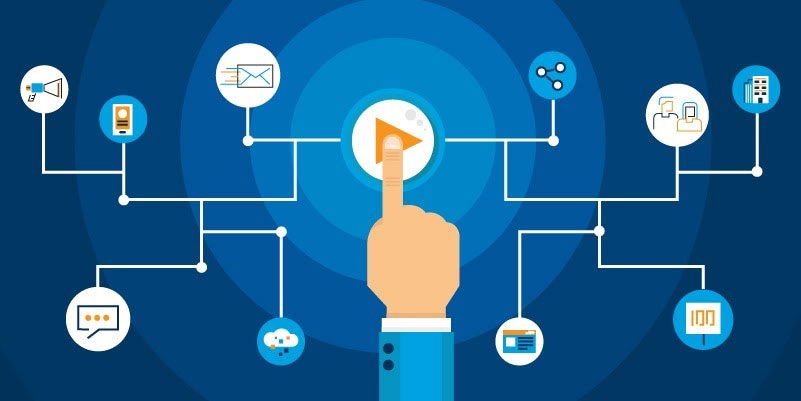
Marketing automation empowers marketers to focus on the strategic initiatives rather than get bogged down with the tactical implementation, and it aligns sales and marketing towards accomplishing common goals. This all adds up to decreased costs and increased revenue.
Marketing Automation Features
Campaign and Email Management
Create and track highly targeted marketing campaigns. Manage end-to-end email campaigns, including database management, target list creation and segmentation, email personalization, and SPAM-compliant auto unsubscribe capabilities.
Website Search Engine Optimization
Connect with your customers early in the buying cycle with search engine-friendly pages.
Landing Page and Forms
Create dynamic landing pages and forms. Build reusable templates to create a consistent look and feel. Instantly create leads in your CRM system for immediate sales follow-up on all form submissions.
Lead Reporting and Analytics
Get comprehensive insight into your marketing programs by program type, lead source, and promotions — in real-time. Seamlessly track lead-to-revenue to measure the ROI of your lead generation programs.
“91% of the most successful users agree that marketing automation is ‘very important’ to the overall success of their marketing across channels.” —Ascend2
Marketing Automation Benefits
Effective Multi-Channel Campaign Management
Streamlines the execution of complex marketing campaigns across multiple channels, including websites, email, events, and social media with a centralized marketing platform.
Improves Sales Collaboration
Aligns marketing and sales goals to improve collaboration and convert leads into customers.
Shortens Your Sales Cycle
Delivers highly relevant dynamic content to prospects at the right time, right place and right channel, guiding them through the buying cycle.
Quantifies and Prioritizes Leads
Captures, identifies, scores and nurtures leads based on profile, behavior, interests, and conversion readiness to deliver sales-ready leads.
Real-Time Visibility
Provides insight into campaign performance and return on investment (ROI) with robust analytics.
To learn how to best use Marketing Automation to increase ROI, check out this article.
As a recognized Marketing Automation leader for the past decade, we work with firms to help them utilize their marketing technology to increase revenue. To see how we can help you, schedule a free consultation or email Lori Berson at lberson@BersonDeanStevens.com.
BersonDeanStevens has been a recognized brand strategy and marketing leader for over 25 years, including over a decade in Marketing Automation. We work in partnership with you to differentiate your brand and achieve your business goals. Client list.

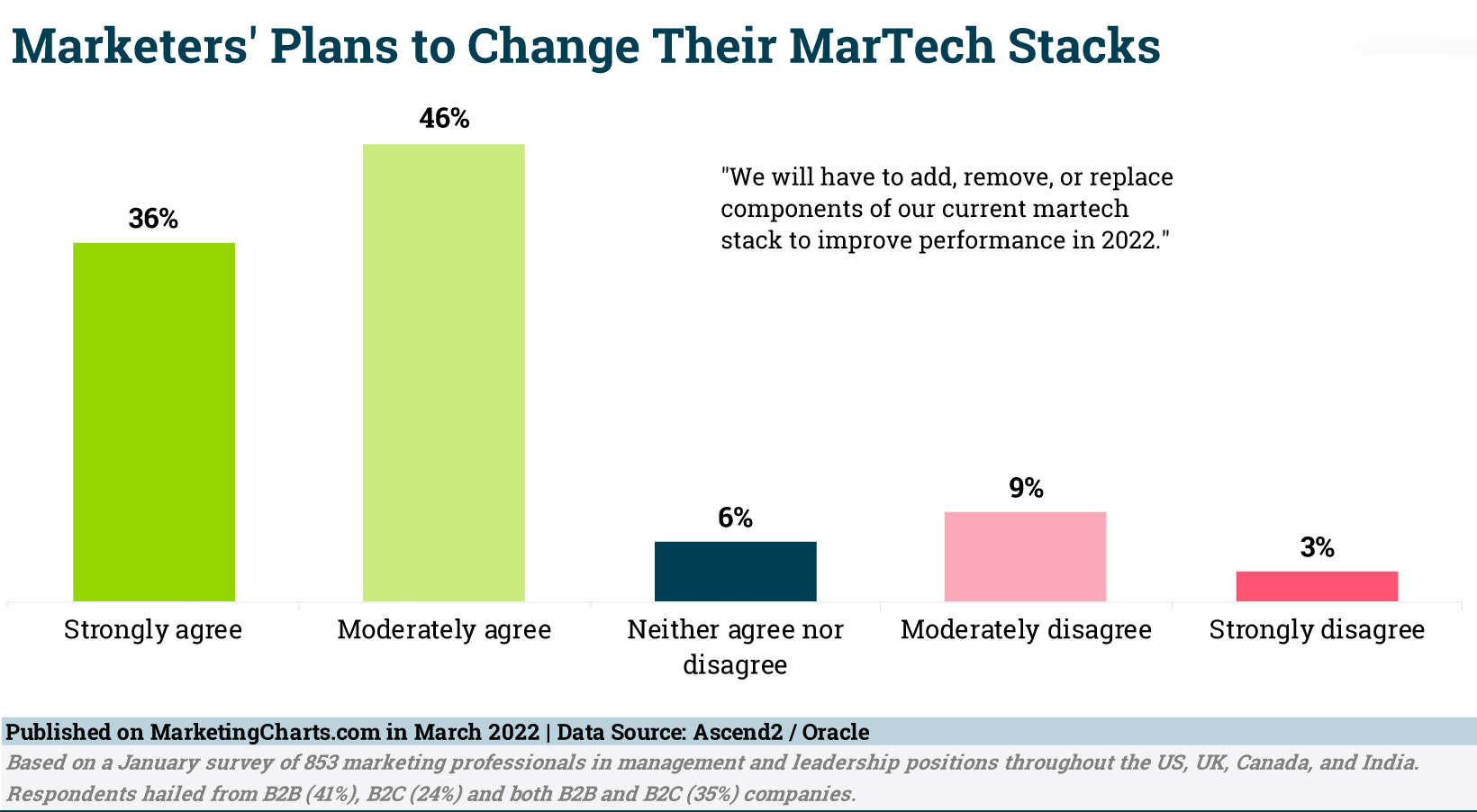
![Marketers’ MarTech Stack Plans [Report]](https://bersondeanstevens.com/wp-content/uploads/2022/06/Martech-Tools-1080x675.jpeg)