
by Lori Berson | Sep 11, 2024 | Creative Services, Marketing, Marketing Strategy
Creativity isn’t just a luxury; it’s a necessity. Whether you are a business owner or a marketer, the need to stand out from the competition and create a memorable brand experience is more pressing than ever. One of the smartest ways to enhance your company’s creative capacity is by bringing in a fractional Chief Creative Officer (CCO). This role is particularly valuable in delivering expert guidance without the full-time cost commitment, ensuring that your marketing strategies are aligned with your business goals and fueled by innovative ideas.
The Creative Edge That Sets You Apart
In an age where businesses are constantly competing for attention, creativity is often the defining factor that sets successful companies apart. A Fractional CCO provides fresh, innovative perspectives that can help breathe new life into your marketing campaigns. Their expertise allows them to identify creative opportunities that might be overlooked by internal teams focused on day-to-day operations.
Hiring a fractional CCO ensures you have a creative leader who can help your brand stay ahead of trends, enabling your business to not only keep up with competitors but to set the pace. They bring a wealth of industry experience, and their role is about more than just generating ideas—it’s about executing them in a way that drives real, measurable results. The ripple effect of having such creative leadership ensures that your brand maintains relevance and positions itself as a leader in the market.
Flexibility and Cost-Effectiveness
Hiring a full-time creative executive may not be feasible for many companies, especially when marketing budgets are stretched thin. A Fractional CCO offers a flexible, scalable solution that provides access to top creative talent without the long-term commitment. They integrate seamlessly with your team, injecting fresh ideas that are tailor-made for your brand’s unique needs. This flexibility ensures that your creative strategy adapts quickly to market shifts and emerging trends, keeping your business ahead of the competition.
This approach not only keeps costs down but ensures that your business is always equipped with the right creative leadership at critical moments. You get the benefit of strategic insights and high-quality creative work without the overhead of a permanent team member.
Strategic Creative Alignment Across the Organization
A Fractional CCO’s influence extends beyond just the marketing department. They play a pivotal role in aligning creativity with business strategy across various departments. From product development to customer service, a CCO ensures that every aspect of your business embodies your brand’s creative vision. By aligning efforts across departments, they create a unified brand experience that resonates with customers at every touchpoint.
For instance, by collaborating with sales and operations, a fractional CCO can ensure that creative ideas are not only innovative but also executable and scalable. Their ability to bridge the gap between departments creates a more cohesive and consistent brand message, which ultimately strengthens your market positioning.
Speeding Up Results with Long-Term Vision
One of the greatest advantages of working with a Fractional CCO is their ability to deliver quick results while keeping an eye on long-term goals. While they can quickly assess your current creative assets and identify opportunities, they also focus on building sustainable strategies that ensure ongoing success. Whether it’s optimizing your current campaigns or reimagining your brand, their impact is felt immediately. At the same time, their long-term vision ensures that these early successes build the foundation for sustainable growth.
In marketing, the right creative decisions can be the difference between a good year and a great one. A Fractional CCO brings the expertise to guide these decisions while also future-proofing your marketing efforts, ensuring that your brand continues to grow.
Why Your Business Needs a Fractional CCO
Hiring a Fractional Chief Creative Officer is a powerful way to drive creativity, innovation, and growth in your business. They offer expert-level insights, ensuring that your marketing strategies are not only aligned with your business goals but also creatively inspiring. For business owners and marketers looking to stay ahead in an increasingly competitive marketplace, a fractional CCO can help you achieve sustainable success by leveraging creativity as a competitive advantage.
Ready to lead with creativity? Schedule a call or email Lori at lberson@BersonDeanStevens.com to help guide your next marketing campaign and witness the transformative impact creativity can have on your business.
BersonDeanStevens (BDS) has been developing creative results-driven marketing strategies, content, campaigns, and programs for over 25 years. And, we bring the knowledge and expertise to incorporate AI when necessary to gain efficiencies and help boost results. Whether you’re looking for a fractional CMO and/or CCO, need assistance when your internal workforce is overloaded, or need consulting from time to time, BDS is the perfect go-to resource. Client list.
by Lori Berson | Aug 6, 2024 | Marketing, Marketing Strategy, Social Media
It’s easy to get caught up in the latest artificial intelligence (AI) tools and advanced technologies and overlook the power of human creativity and artistic expression in marketing. However, these elements could be your secret weapons for gaining a significant edge over your competitors. Here’s why infusing creativity and art into your marketing is more crucial than ever.
Breaking Through the Digital Noise
In today’s oversaturated digital space, we are bombarded with countless ads and messages daily. Creative, artistically driven campaigns cut through this noise, capturing attention in ways that standard, AI-generated content simply can’t match. By presenting your brand in a unique, visually striking manner, you’re more likely to stop the scroll and engage your audience. Example: Apple’s “Shot on iPhone” campaign.
Emotional Connection: The Ultimate Differentiator
While AI can analyze data and optimize campaigns, it struggles to replicate human emotions. This is where the human touch shines. Creativity taps into the emotional core of your audience, creating connections that go beyond mere transactions. This emotional resonance builds brand loyalty, encourages word-of-mouth marketing, and creates a customer base that chooses your brand not just for its products and/or services, but for its identity and values. Example: Dove’s “Real Beauty” campaign.
Memorable Brand Identity
In a sea of similar products and services, a creatively crafted brand identity stands out. Artistic elements in your marketing – through visual design, storytelling, or imaginative campaigns – make your brand more memorable and enhance the overall customer experience, differentiating your brand in ways that technology alone cannot. This translates directly into a competitive advantage, as customers are more likely to recall and choose your brand when making purchasing decisions. Example: Nike’s “Just Do It” campaign.
The Human Touch in a Tech-Driven World
As automation and AI become more prevalent in marketing, the human elements of creativity and artistic expression become even more valuable. By emphasizing creativity and art in your marketing, you signal to your customers that there are real people behind your brand—people with imagination, empathy, and a genuine desire to connect. This human touch can be a powerful differentiator in a market where many brands may come across as cold or impersonal. Example: Slack’s hand-drawn illustrations.
Innovation that AI Can’t Replicate
Truly groundbreaking ideas often come from creative leaps that AI can’t make. With artistic thinking, you’re more likely to develop innovative campaigns, products, and services that set new industry standards. This innovation-driven approach positions your brand as a leader rather than a follower. Example: the British Airways ‘Windows’ campaign.
Balancing Art and Analytics
The most effective marketing strategies combine the insights of data analytics with the impact of creative expression. While your competitors might rely heavily on data-driven decisions, your edge comes from interpreting that data through a creative lens, resulting in campaigns that are both targeted and inspirational. Example: Netflix’s personalized recommendations and artwork.
Cost-Effectiveness
Contrary to popular belief, creative campaigns don’t always require big budgets. A truly innovative idea can generate significant buzz and engagement without the need for extensive advertising spend. This cost-effectiveness can provide a substantial competitive advantage, especially for smaller brands competing against larger, well-funded competitors. Example: Airbnb’s “Made Possible by Hosts” campaign uses user-generated content to showcase the experiences of guests at various properties.
Increased Shareability
Creative content is inherently more shareable on social media platforms. When people encounter something unique, visually appealing, or emotionally resonant, they’re more likely to share it with their networks. This organic spread can dramatically increase your reach without additional cost, amplifying your marketing efforts far beyond your initial audience. Example: The Museum of Ice Cream pop-up museum.
Enhanced Perceived Value
A well-designed presentation can elevate the perceived value of your products or services. When marketing materials are thoughtfully designed and creatively executed, they can make your offerings appear more premium or desirable. This perceived value can justify higher price points and improve profit margins. Example: Tiffany & Co.’s blue box.
Improved Employee Engagement
A focus on creativity in marketing can have positive ripple effects throughout your organization. When employees see their company producing innovative, artistic campaigns, it can boost morale and encourage a culture of creativity. This can lead to increased employee engagement and productivity across departments, indirectly strengthening your competitive position. Example: the Zappos “Delivering Happiness” initiative.
Enhanced Customer Loyalty
Creativity in marketing doesn’t just attract new customers; it helps retain existing ones. When your brand consistently delivers creative, engaging content, it gives customers more reasons to stay connected with your brand beyond just your products or services. This enhanced loyalty can significantly reduce customer churn. Example: Starbucks’ “Starbucks Rewards” loyalty program.
Differentiation in Saturated Markets
In markets where products or services are similar, creativity becomes a key differentiator. A unique marketing approach can set your brand apart even when your offerings are comparable to competitors. This differentiation can be the deciding factor for customers choosing between similar options. Example: Method’s cleaning products and branding.
Tackling Complex Topics
Some products, services, and brand messages can be complex or technical. Creative approaches in marketing can simplify these complexities, making them more accessible and understandable to a broader audience. This ability to communicate complex ideas effectively can give you an edge, especially in knowledge-intensive industries. Example: Duolingo simplifies language learning through gamification and a friendly mascot.
The Competitive Power of Creativity
In the AI-driven future of marketing, creativity is not just a nice to have; it’s an essential competitive advantage. By infusing your marketing strategies with creative thinking and artistic expression, your brand can create marketing campaigns that not only sell products and services but also inspire, engage, and leave a lasting impact on your audience – giving you a powerful edge over competitors who may be relying solely on data and algorithms.
According to Dentsu Creative’s 2024 CMO Report, 83% of global CMOs believe that creative ideas can transform businesses and 81% see creativity as more important to their business than ever.
Ready to gain a competitive advantage with the power of creativity? To get started, schedule a call or email Lori at lberson@BersonDeanStevens.com.
BersonDeanStevens (BDS) has been developing creative results-driven marketing strategies, content, campaigns, and programs for over 25 years. And, we bring the knowledge and expertise to incorporate AI when necessary to gain efficiencies and help boost results. Whether you’re looking for a fractional CMO, need assistance when your internal workforce is overloaded, or need consulting from time to time, BDS is the perfect go-to resource. Client list.
![Most Important Marketing Tactics Contributing to Campaign Performance [Report]](https://bersondeanstevens.com/wp-content/uploads/2022/05/Marketing-Tactics.webp)
by Lori Berson | May 14, 2022 | Marketing
Almost 2,000 marketers around the world were asked by Nielsen to rank the order of importance of a variety of marketing tactics from most important (1) to least important (9) when considering the contribution to campaign performance.
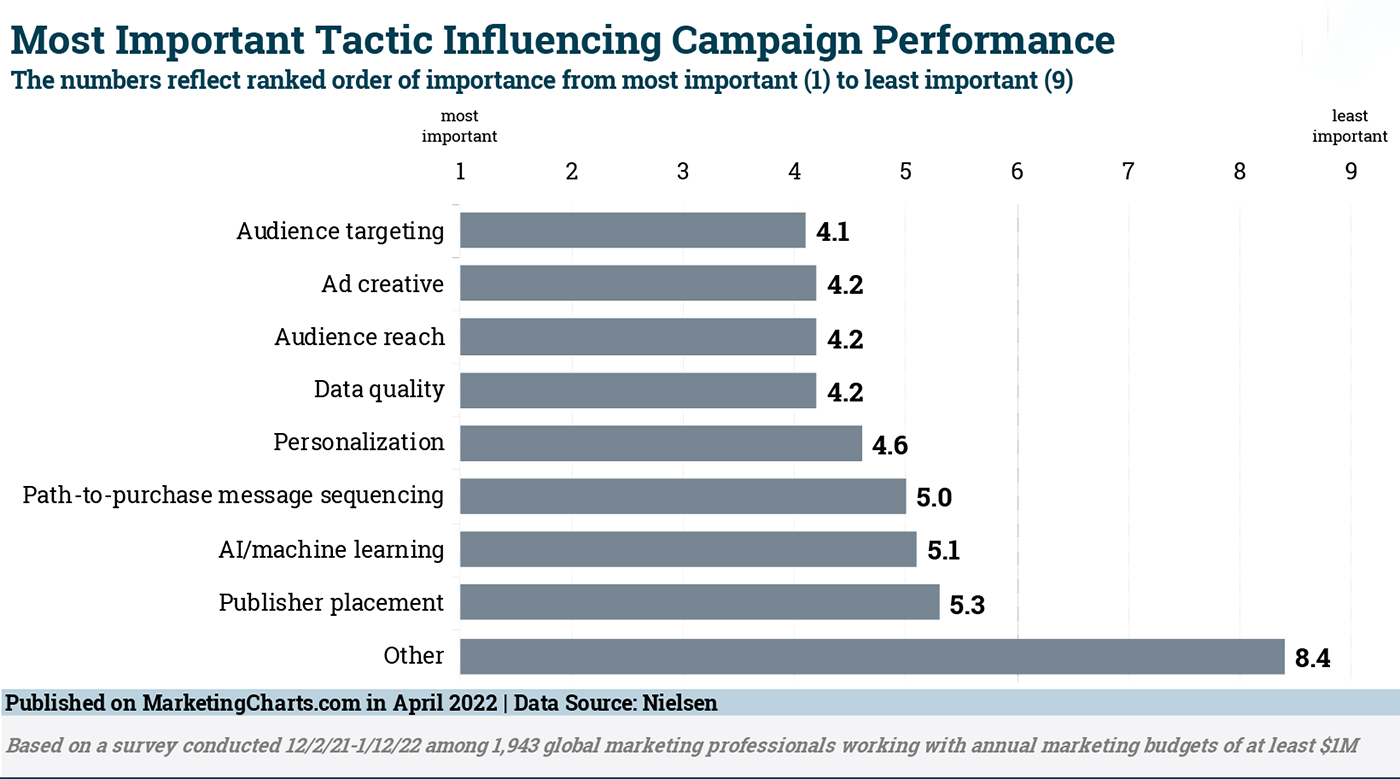
The results of Nielsen’s 5th Global Annual Marketing Report indicate that audience targeting came out on top, with an average rank of 4.1. Following closely was a grouping of ad creative, audience reach, and data quality, each with an average rank of 4.2.
Rounding out the top 5 was personalization (average rank of 4.6), ahead of path-to-purchase message sequencing (5), AI/machine learning (5.1), and publisher placement (5.3).
Almost 5 years ago Nielsen released a report which found that at least for CPG campaigns, creative (quality/messaging) had a far greater contribution to sales lift from advertising than did reach or targeting. A more recent survey from Westwood One and Advertiser Perceptions, however, revealed that marketers and agencies believed that targeting was a bigger driver of sales than creative or reach.
One factor unique to this latest survey is data quality. Only about 1 in 4 (26% of) survey respondents strongly agree that they have access to the quality audience data they need to get the most out of their media budget, though it’s true that an additional 45% somewhat agree that they do. This is supported by recent research from Ascend2, in which only 1 in 3 respondents said that the quality of their data allowed them to make effective decisions on where to spend marketing and/or sales resources, though another 55% somewhat agreed.
More than 1 in 3 of the Nielsen survey respondents report the following to be extremely or very difficult: data access (36%); identity resolution (36%); actionable data insights (36%); data accuracy/quality (35%); and data scale (34%). An additional third or so find these topics to be moderately difficult.
About the Data: The results are based on an online survey conducted December 2, 2021-January 1, 2022 among 1,943 global marketing professionals at or above the manager level, working with annual marketing budgets of at least $1 million. Respondents were from the auto, financial services, FMCG, technology, health care, pharmaceuticals, travel, tourism, and retail industries.
Need assistance with your marketing strategies? Schedule a call or email Lori Berson at lberson@BersonDeanStevens.com.
BersonDeanStevens has been a recognized brand strategy and marketing leader for over 25 years, including over a decade in marketing and sales automation. We work in partnership with you to differentiate your brand and achieve your business goals. Client list.
