
- Activity doesn’t equal impact: 95% of B2B leaders admit their execution needs work; the core issue is a lack of integration across channels, not a lack of output.
- Strategy must precede tactics: Define the core business problem, primary target audience, and success metrics before launching campaigns, creating content, or buying new tools.
- Creative work drives true differentiation: Modern AI makes asset production fast, but strategic creative execution is what turns abstract business goals into clear, memorable value propositions.
- Brand and demand are interdependent: Generating short-term leads is significantly harder without long-term brand equity; every touchpoint must reinforce the same core value.
- AI scales your current baseline: Technology accelerates whatever strategy you give it; automating unclear positioning or generic messaging only produces mass confusion faster.
- Marketing belongs in core growth planning: Expecting revenue results requires involving marketing early across positioning, buyer needs, and sales alignment, rather than treating it as a downstream production vendor.
Most B2B companies already invest heavily in marketing. They maintain websites, run email programs, create social content, use automation tools, analyze data, and test AI. But more marketing does not always produce better business results.
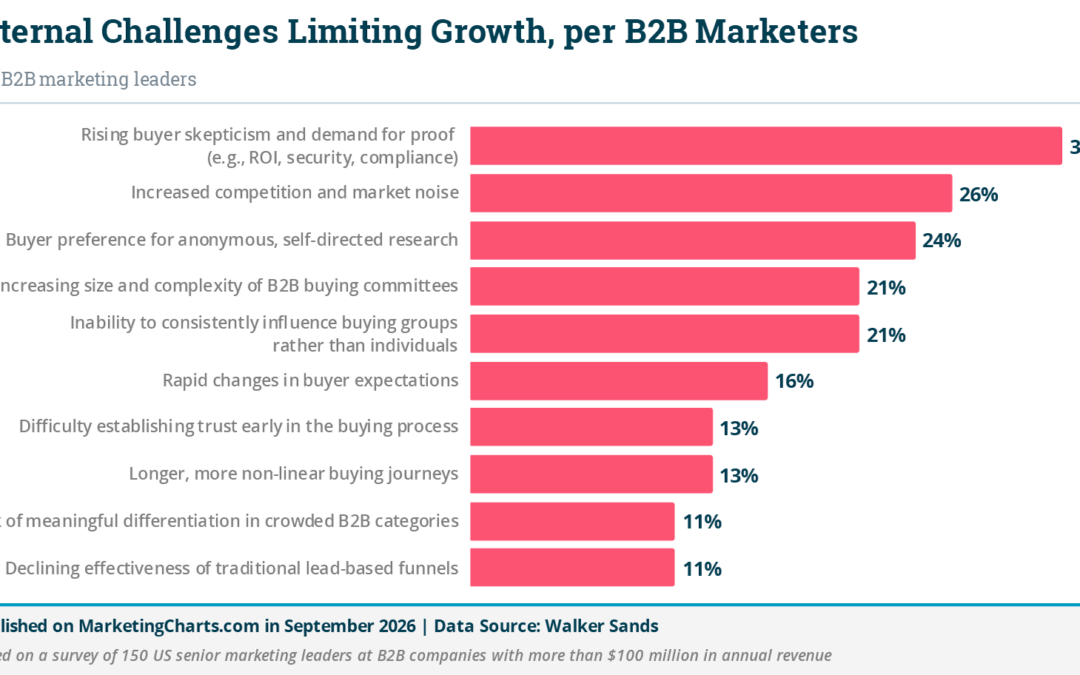
New research from Walker Sands shows a clear gap. Almost every B2B leader surveyed said they understand what modern marketing should look like. But 95% also said their marketing must improve to compete with leading brands. The fundamental issue isn’t a lack of activity; it’s a lack of integration.
Strategy must guide the work. Creative must make the strategy clear and useful. Execution must stay consistent. Measurement must show whether the work supports the business goal.
When every element of your marketing engine works in unison, it stops being a cost center and starts driving measurable financial outcomes:
- Lower Customer Acquisition Cost (CAC): Strategic alignment eliminates wasted spend on non-performing tactics and disconnected tools.
- Faster Pipeline Velocity: Consistent, compelling messaging across sales and marketing shortens complex B2B buying cycles.
- Higher Deal Win Rates: Clear, differentiated creative positioning protects margins against lower-cost competitors.
Disconnected Marketing vs. Connected Marketing
| Marketing Area | Disconnected Approach | Connected Approach |
| Content Strategy | Produced for volume based on team assumptions. | Built to solve specific buyer questions and needs identified by sales. |
| Technology & AI | Mass produces generic assets across isolated tools. | Scales approved positioning and accelerates personalized buyer journeys. |
| Measurement | Focuses on clicks, opens, impressions. | Focuses on marketing activity to business outcomes. |
| Sales Alignment | Sales creates its own materials because existing content isn’t useful. | Sales uses marketing materials to close deal conversations. |
Start with Strategy, Not Tactics
The Study reveals 67% of marketing leaders struggle to identify which business results executives expect them to impact, while 79% find it difficult to demonstrate marketing ROI altogether.
This gap creates a basic problem: you cannot measure marketing performance effectively if leadership hasn’t agreed on what marketing must achieve. This is why strategy must come before tactics. Before your launch another campaign, produce more content, redesign a website, or add a new tool, ask your team:
- What specific business problem must we solve?
- Which audience matters most right now?
- What must the audience understand and act on?
- Why should buyers choose us over the competition?
- Which marketing activities can produce the desired outcome?
- How will we measure success?
These questions help turn marketing from a list of tasks into a coordinated business function.
Many Problems Start Before Execution
B2B leaders identified five areas where their marketing needs to improve:
- Measurement and performance insights.
- Consistent marketing operations.
- Cross-channel coordination.
- Testing and validating new channels.
- Long-term brand building and awareness.
Notice what is not on this list. Leaders aren’t asking for more emails, higher content volume, or more social posts. Their challenges start much earlier. Companies need clear priorities, channels to support each other, distinct brand positioning, useful performance data, and operational systems that keep teams aligned.
These are strategy problems before they become production problems.
Strategy Is Not Enough
A good strategy can still fail if the execution gets ignored. In many B2B organizations, creative work is treated as a final design step. That narrow view misses its true value: creative strategy helps turn business goals into messages that people can understand, remember, and act on.
While strategy defines the target audience and value proposition, creative work communicates that value. For a B2B organization, strategic creative work can:
- Explain complex services in simple terms.
- Build a clear and consistent visual identity that builds immediate recognition.
- Turn product features into meaningful customer outcomes.
- Create campaigns that help sales teams start better conversations.
- Make complex information easier to compare.
- Show buyers why the company is different.
This work matters even more because AI can create functional content in seconds. While modern AI drastically speeds up asset production, it does not guarantee differentiation. True value comes from knowing what to say, why it matters, and how to communicate it clearly.
Brand and Demand Must Work Together
Companies often treat long-term brand building and short-term demand generation as competing priorities, when they should support each other. The data shows that B2B leaders recognize long-term brand building as an area that needs improvement. That matters because demand generation becomes harder when buyers do not know your company, understand your value, or see a clear difference between you and your competitors.
A connected strategy harmonizes brand and demand across every touchpoint. For example:
- Your website supports the same value proposition used by sales.
- Your thought leadership validates your expertise.
- Your email marketing matches the tone and authority of your social channels.
- Your sales materials continue the same message used in campaigns.
Connected marketing also requires feedback from sales. Sales teams hear buyer questions and objections directly. Marketing can use that information to improve strategy, content, and messaging.
AI Scales Good Marketing and Bad Marketing
B2B leaders also show strong interest in AI and marketing automation. AI can help with research, content drafting, data analysis, and repetitive tasks. But technology cannot fix a weak strategy.
- If your positioning is unclear, AI can create more unclear content.
- If your messaging is generic, AI can create more generic content.
- If teams do not agree on priorities, automation can help them move in different directions faster.
Before asking “What can we automate?” ask “What must we improve, and where can technology help?” First, get the direction, then use technology to scale the work.
Marketing Must Be Part of Growth Strategy
The research also shows a gap between expectations and involvement. 89% of B2B leaders expect marketing to help drive revenue. But only 45% said executive leaders view marketing as a core part of growth strategy. That creates a problem.
Companies expect marketing to support growth, but some still treat it mainly as a production function. Marketing should be involved earlier. It should help connect:
- Business goals and revenue targets.
- Buyer needs and pain points.
- Competitive positioning and messaging.
- Creative direction and sales enablement.
- Marketing channels and technology.
- Measurement frameworks and analytics.
When strategy and creative work together, business goals become easier to communicate and support through marketing. Strategy without strong creative can be difficult to see. Creative without strategy can attract attention without supporting the business goal. The strongest marketing connects both.
Quick Audit: Is Your Marketing Connected?
Ask your leadership team these three questions:
- Can everyone identify your top 3 marketing priorities?
- Does your primary sales presentation use the same core positioning as your website?
- Can your marketing reports connect key campaigns to qualified pipeline or revenue?
If the answers are not consistent, your marketing may have an alignment problem. That does not mean you need more tactics. It may mean the existing work needs to connect more clearly.
Your 30-Day Starting Point
Start with a simple review. Gather your:
- Website homepage.
- Main sales presentation.
- Latest email campaign.
Compare them side-by-side. If the positioning, tone, and value proposition don’t match, you have found your primary growth bottleneck.
Turn Disconnected Marketing Into Connected Marketing
Adding more tactics will not fix unclear priorities, inconsistent messaging, or disconnected channels.
BersonDeanStevens helps B2B companies connect strategy and creative execution so their marketing supports clear business goals. We help companies improve positioning, messaging, creative direction, content, campaigns, and marketing systems so the parts work together.
Is Your Marketing Working Together?
Schedule a complimentary call with Lori at lberson@bersondeanstevens.com or use her calendar to identify where your strategy, creative, or execution may need better alignment.
BersonDeanStevens (BDS) has developed creative, results-driven marketing strategies, content, campaigns, and programs for over 27 years – with AI incorporated where it adds efficiency and lifts results. Whether you need a fractional CMO, assistance for an overloaded team, or strategic counsel from time to time, BDS is your go-to resource. Client list.