
Key Takeaways
- AI use is already widespread in marketing and is growing quickly among organizations. Individual AI productivity is far more common than true workflow automation.
- The best starting point is a business bottleneck, not an AI tool.
- Poor processes should be fixed before they are automated.
- AI performance depends on good data, clear rules, ownership, training, and human review.
- Not every task should be automated.
- Start with one high-value, manageable workflow.
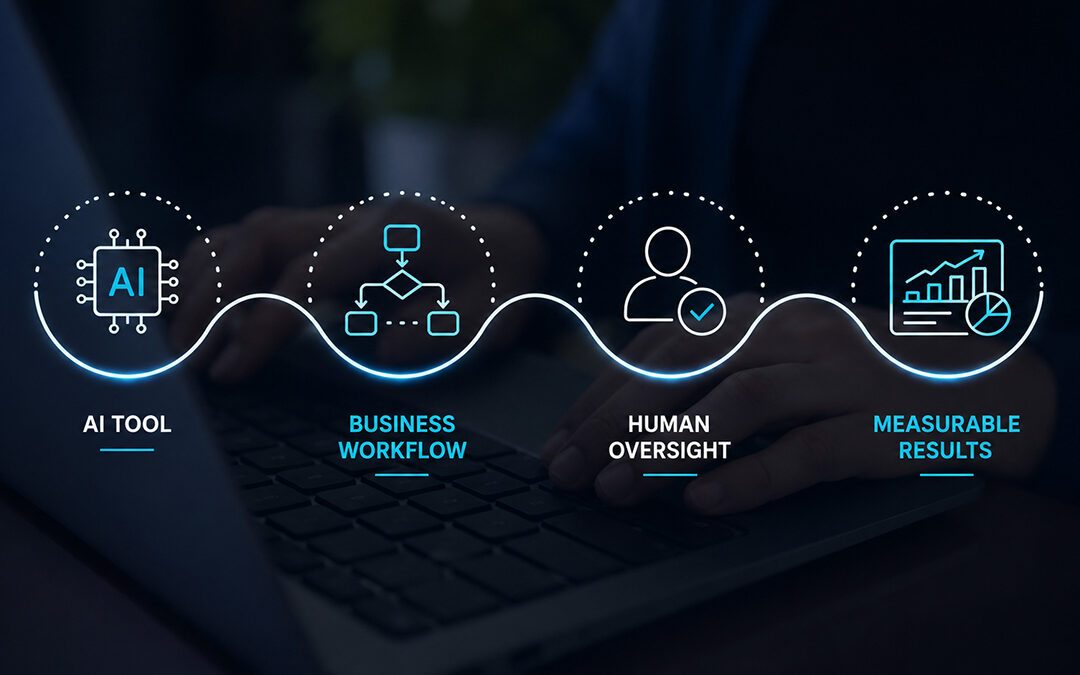
- Establish a baseline, measure the outcome, and expand only after the workflow proves useful.
- The long-term advantage will not come from access to AI. It will come from how well the company applies it.
AI adoption is no longer the issue I’m most concerned about. What concerns me is how many companies are using AI without knowing whether it is actually improving the business.
Employees are drafting emails, researching competitors, summarizing meetings, creating content, analyzing information, and experimenting with AI features inside the software they already use. That is progress.
But there is a big difference between using AI and building a better business with AI.
Recent research shows that AI adoption is already widespread. Salesforce’s global survey of 4,850 marketing decision-makers found that 75% of marketing organizations were either experimenting with or had fully implemented AI. High-performing marketing teams were 2.5 times more likely than underperforming teams to have fully integrated it.
A government census revealed small businesses are moving in the same direction. SMB AI use shows that employees are increasingly using AI for writing, research, marketing, customer-facing work, and recurring administrative tasks. Yet according to the U.S. Chamber of Commerce Foundation 2026 study, only 6% of small-business workers report using AI to automate workflows with minimal human involvement.
That is the gap I think business leaders should be paying attention to.
The next stage of AI is not getting employees to try it. It is about figuring out where AI can improve how the company actually works.
Using AI Is Not the Same as Integrating AI
Most companies did not begin using AI with a formal strategy. Someone started using ChatGPT. Someone else began using an AI feature inside HubSpot, Salesforce, Microsoft, Adobe, Google, or another platform.
Marketing used it to create content. Sales used it for research and follow-up. Employees began using it to summarize meetings, review documents, or brainstorm ideas. That experimentation has value. It helps people learn what AI can and cannot do. But experimentation eventually reaches a limit.
The U.S. Chamber of Commerce research illustrates that clearly. Among small-business workers using AI, 64% primarily use it for individual productivity, while only 6% use it for workflow automation with minimal human involvement.
The SMB research illustrates that clearly. Among small-business workers using AI, 64% primarily use it for individual productivity, while only 6% use it for workflow automation with minimal human involvement.
Marketing shows the same pattern. AI is now being used for content optimization, content creation, ideation, workflow automation, social strategy, data analysis, and personalization. But implementation maturity, data quality, training, governance, and trust remain significant barriers.
That tells me: The technology is becoming easier. The business application is still the hard part.
Start With the Bottleneck, Not the AI Tool
When business leaders talk to me about AI, the conversation often begins with software.
- Should we use ChatGPT or Claude?
- Do we need AI agents?
- What can we automate?
- Should we connect AI to our CRM?
Those are reasonable questions. But they are usually not the first questions I would ask.
A better starting point: Where is your company losing time, money, accuracy, responsiveness, or opportunity today?
AI is most useful when it solves an existing business problem. For example, a marketing team might be spending too much time:
- Creating versions of similar emails or campaigns.
- Searching for information across documents and systems.
- Repurposing content.
- Preparing campaign reports.
- Updating CRM records.
- Reviewing work for errors or missing information.
- Researching prospects or competitors.
- Following up after meetings.
- Answering the same internal questions repeatedly.
Those are not AI problems. They are business problems that AI may be able to help solve. That distinction matters because companies sometimes buy an AI tool first and then search for a reason to use it.
I recommend doing the opposite. Find the friction first.
Why Companies Get Stuck
The research points to several reasons why businesses struggle to move from experimentation to measurable results.
1. Employees Know How to Use AI, But Not How to Use It Effectively.
Marketers are already using AI, but training has not kept pace. The research shows that 67% of marketers cite a lack of training as a barrier to AI adoption. Other barriers include a lack of AI strategy, skills, ownership, and governance.
This is why I do not think another general “how to prompt ChatGPT” seminar is enough. Employees need training tied to their actual work.
- A marketer needs to understand how AI can support campaign development, content review, segmentation, analysis, and reporting.
- A salesperson may need help with prospect research, follow-up, proposal preparation, and CRM updates.
- A business leader needs to understand prioritization, ROI, risk, implementation, and where human oversight is required.
The real question is not: How do we teach people to use AI?
It is: How should AI change the way this job gets done?
2. Companies Try to Automate Processes That Are Already Unclear
This is one of the biggest mistakes I see.
If a workflow is inconsistent before AI, automation can simply make the inconsistency happen faster.
Consider lead follow-up. Before automating it, the company needs to define:
- What makes a lead qualified?
- Who owns the lead?
- How quickly should someone respond?
- What information is required?
- What happens when information is missing?
- When does a person need to intervene?
- What counts as a completed handoff?
If those questions do not have clear answers, AI will not solve the problem.
The SMB research supports this. Reliable workflow automation requires standardized processes, connected systems, usable data, ownership, testing, and ongoing maintenance. In other words: Do not automate a bad process. Fix the process first.
3. AI Can Only Work with The Information You Give It
This issue becomes especially important in marketing.
AI can help personalize customer communications. But it needs accurate customer information.
It can analyze CRM data. But poor CRM data will produce poor analysis.
It can answer questions from company documents. But only if those documents are current, approved, and accessible.
It can create content quickly. But speed does not help if the content sounds generic, makes unsupported claims, or does not reflect your brand.
Research on marketing AI adoption points to this same problem. Marketers are using AI for increasingly sophisticated applications, but data readiness and trust continue to limit what companies can do with it.
AI implementation is not just a technology project. It is also a data, process, and management project.
4. Nobody Owns The Outcome
Individual AI adoption often happens from the bottom up. Employees discover a tool and begin using it. That’s easy.
Operational AI requires someone to take responsibility for the result. Leadership needs to decide:
- Which AI opportunities are worth pursuing.
- Which tools are approved.
- What information employees can use.
- Where human review is required.
- What success looks like.
- Who owns the workflow.
- How results will be measured.
- When a workflow should be expanded or stopped.
Without that structure, companies can end up with plenty of AI activity but very little business improvement.
The Goal Should Not Be to Automate Everything
There is a lot of pressure right now to automate as much as possible. I think that is the wrong objective. The better question is:
Which parts of the work should AI handle, and which parts become more valuable when people handle them?
AI is especially useful for repetitive, information-heavy, and data-driven work. It can:
- Review large amounts of information.
- Generate first drafts.
- Summarize content.
- Compare documents.
- Find patterns.
- Categorize information.
- Execute well-defined steps quickly.
- Assist with analysis and decision support.
Humans remain essential for strategy, judgment, creativity, context, relationships, accountability, and decisions where the consequences matter. That balance has been central to how I think about AI.
I have used the idea of treating AI almost like an additional FTE. But I think there is an important condition attached to that idea. An AI “employee” still needs a job description, approved information, processes, supervision, quality standards, and performance measures.
You would not hire an employee, give that person access to everything, provide no training, establish no procedures, and assume productivity would improve. Yet that is close to how some companies are approaching AI.
Don’t Boil The Ocean, Start With One Workflow
I recommend choosing one workflow where there is a clear business problem. Then work through these questions.
What happens today?
Document the current process. Do not assume everyone follows the same steps.
Where is the friction?
Look for:
- Repetitive work.
- Delays.
- Errors.
- Rework.
- Poor access to information.
- Inconsistent follow-up.
- Unnecessary manual steps.
- Bottlenecks that depend on one person.
What should improve?
Define the outcome before selecting the technology. That might mean:
- Reducing a four-hour task to one hour.
- Shortening response time.
- Improving accuracy.
- Reducing repetitive work.
- Increasing follow-up consistency.
- Launching campaigns faster.
- Giving employees more time for higher-value work.
Which steps could AI assist with?
Not every part of the workflow needs AI. Sometimes conventional automation is better. Sometimes the process simply needs to be redesigned.
Where is human judgment required?
Create deliberate checkpoints for review and approval. Human oversight should not be an afterthought.
How will you measure the result?
Establish a baseline before making the change. For marketing, that might include:
- Production time.
- Campaign launch time.
- Conversion.
- Engagement.
- Cost per lead.
- Pipeline contribution.
- Errors and corrections.
- Rework.
For operational workflows, measures might include:
- Time saved.
- Turnaround time.
- Error rate.
- Customer response time.
- Employee capacity.
- Accuracy.
This Is Why I Start With an AI Assessment
The BersonDeanStevens AI Opportunity Assessment begins with the business rather than the software.
The assessment reviews goals, systems, workflows, constraints, data handling, risk, employee adoption, and opportunities to improve efficiency, accuracy, access to information, and service. Opportunities are then prioritized based on business impact, implementation effort, risk, and readiness.
The result is a practical roadmap that helps answer four questions:
- Where can AI deliver value?
- What should we prioritize?
- What should remain under human control?
- How will we know if it worked?
That is a much more useful outcome than a long list of AI tools.
Assessment Is Only the Beginning
Knowing what to do does not mean it will get done. I think this is going to become one of the larger AI challenges for organizations.
A management team can identify ten good AI ideas in one meeting. That does not mean the business should attempt all ten.
I recommend selecting one high-value, manageable workflow, then building, testing, measuring, and refining it before moving to the next one. That is the thinking behind the BDS AI Concierge Service.
The AI Concierge Service provides hands-on support to select, build, test, implement, and improve one priority AI-assisted workflow at a time. The service includes working sessions, custom workflows, documentation, support, performance measures, and ongoing guidance on where to focus next.
The objective is not simply to make people better at using AI. It is to build a growing set of repeatable workflows that improve the business.
Access to AI Will Not Be the Competitive Advantage
This is the point I think many companies are missing. Your competitors have access to the same AI models you do. They can buy many of the same platforms. Their employees can use many of the same tools. AI itself is becoming widely available. So access is unlikely to remain a meaningful competitive advantage.
A company that improves its processes, organizes its knowledge, cleans up its data, trains employees, establishes safeguards, and deliberately incorporates AI into high-value work can become faster, more consistent, and more capable.
A company that simply gives everyone an AI account may produce more work without producing better results. That is the distinction I would focus on now.
The first stage of AI adoption was experimentation. The next stage is operationalization. And that takes more than a prompt.
For help turning AI opportunities into practical workflows and measurable business results, reach Lori at lberson@bersondeanstevens.com or schedule a complimentary call.
BersonDeanStevens (BDS) has developed creative, results-driven marketing strategies, content, campaigns, and programs for over 27 years – with AI incorporated where it adds efficiency and lifts results. Whether you need a fractional CMO, assistance for an overloaded team, or strategic counsel from time to time, BDS is your go-to resource. Client list.